Tag: excursions

  • The Best of Both Worlds

    The Best of Both Worlds

    Academia Tica has two campuses. Both are situated in classic, well-maintained houses, surrounded by beautiful gardens and staffed by teachers trained in Instituto Cervantes methodology. But beyond the school walls, Jacó and Coronado as are different from each other as the beach is from the mountains.

    Coronado

    Coronado refers to a canton or county, half a dozen neighborhoods and villages that climb up the hills outside of Costa Rica’s capital city. It is literally in the middle of the country, equal distance from the Caribbean and Pacific coasts, from Panama and Nicaragua. Eons ago these temperate highlands were formed by volcanic eruptions. Today part of the forests have been cut into pasture, producing food and dairy products for the valley below, a metropolitan area of 1.8 million people, nearly half the country’s total population.
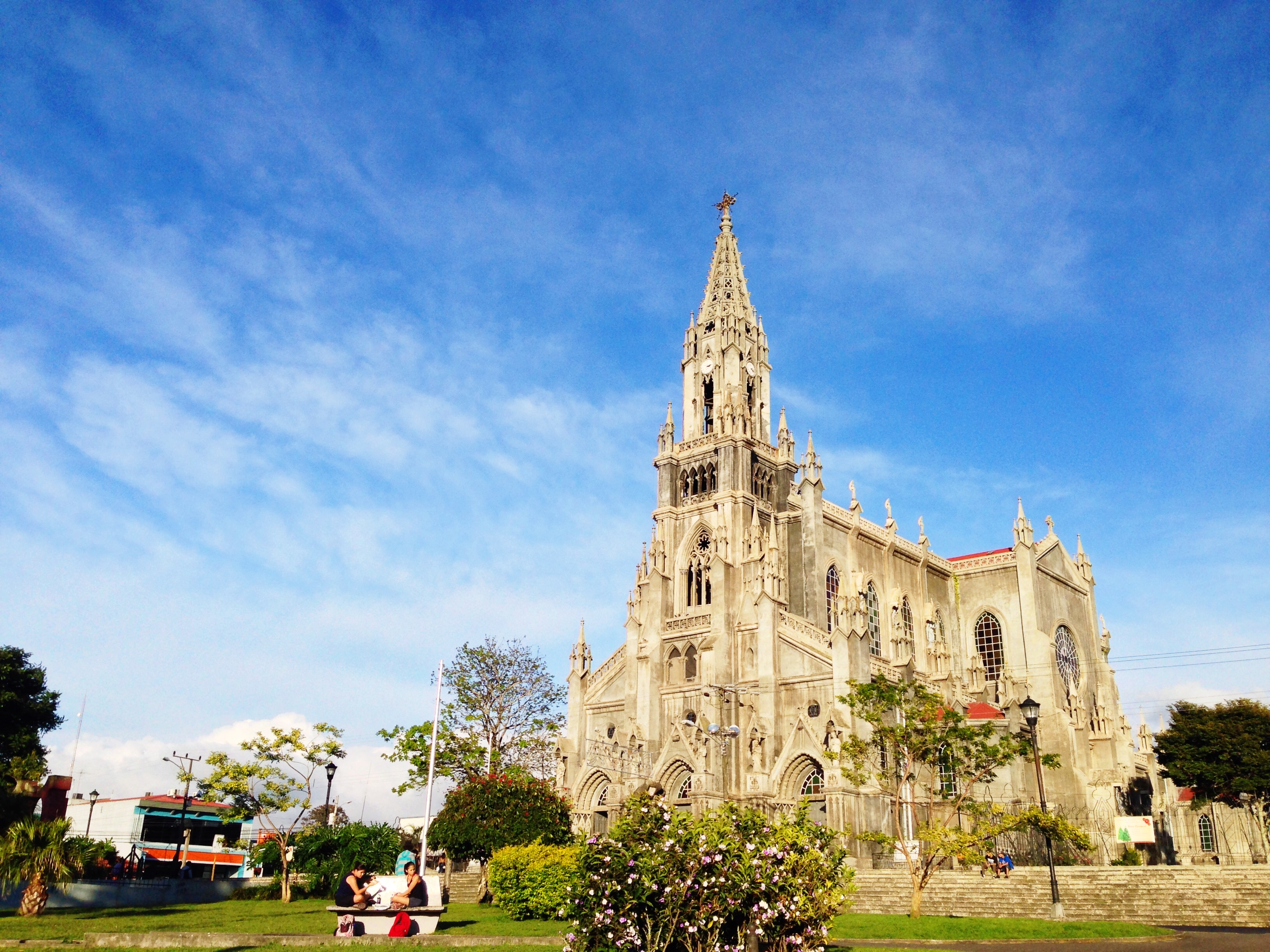
    The church is at the heart of Coronado, a short walk from the school.
    The church is at the heart of Coronado, a short walk from the school.

    With a geography that relates as much to cloud forests as urban plazas, and a cultural identity linked to cattle ranching, Coronado is a mixing point. Parts of it look like country scenes: herds grazing emerald seas, grandmas selling cheese off front porches, families with backyard trout ponds serving up the freshest fish imaginable.

    Yet, there are unmistakable signs that for thousands of commuters, city life begins here. Walled modern homes abut cow pastures. People brunch and work on their laptops at a gourmet bakery and coffee bar. A family-run soda sells typical “casado” plates: heaps of rice, beans, sweet plantains and salad for about $2.50 USD;  while the menu and prices at nearby Papa John’s Pizza chain could be anywhere in the world. In the town’s busy center, life revolves around an impressive neo-Gothic-style Catholic Church.
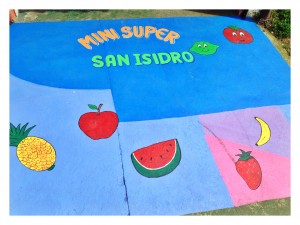
    Minisuper
    Hand painted sign for a fresh fruit and vegetable super near the Coronado school.
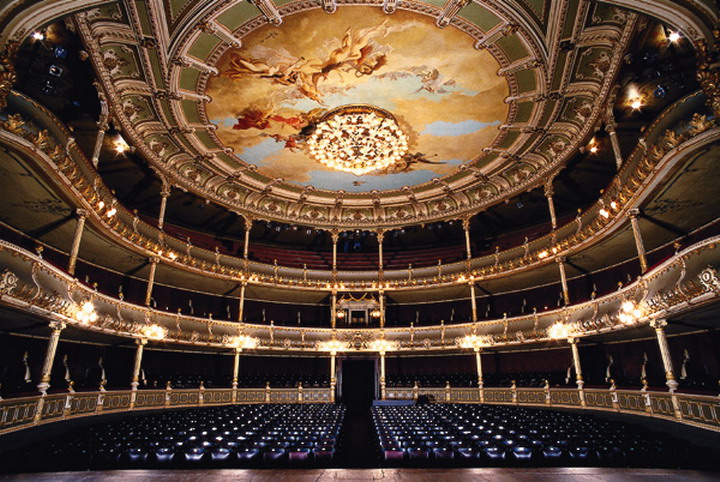
    The National Theatre is one of many cultural meccas close to Coronado.
    The National Theatre is one of many cultural meccas close to Coronado.

    The bus costs about 60 U.S. cents. It can take you in two general directions: up or downhill. Up heads towards Las Nubes, a village appropriately named The Clouds, known for cool climate, incredible views and agriculture. Here you can go horseback riding, catch your own lunch or visit a pristine cloud forest. Further up is Cascajal and Monserrat, the latter immersed in the dense cloudforests that limit with Braulio Carrillo National Park. Down leads to central San José, epicenter of urban culture and government, where dozens of theaters, busy markets and museums await.

    Because Coronado is relatively unchanged by foreign tourism, ordinary stuff like buying food, going out for coffee, getting a haircut and practicing common courtesy are all part of everyday life and your Spanish language education. Buy fresh fruits and veggies every week at a farmer’s market that brings producers from all over the region, or pick up your goods at a small shop down the street with a charming hand-painted sign.

    Jacó Beach

    Jacó is the nearest popular beach to San José and an easy morning drive from Coronado. The 2.5 mile long sandy beach break offers consistent swell year round, with bigger waves to the North and smaller, beginner-friendly waves to the South. Tethered to this famous beach are innumerable restaurants, hotels and bars, along with hospitals, major stores and most any amenity one could look for. Many students customize their schedule with Academia Tica to include stays at both Coronado and Jacó Beach.

    A few generations ago, Jacó was home to a few dozen families, rice fields and roving cattle herds. People tumbled in and out by rock road, taking a ferry across the crocodile-infested Rio Grande de Tárcoles to access distant hospitals or go to the movies in bigger towns to the Northeast. By the mid-20th century people here began to rent palm-roofed cabañas to visitors from the Central Valley and abroad. Today Jacó is book-ended by luxury resorts, a smooth highway delivering visitors from all over the world. People come for the beach, the party scene and the wild places still a stone’s throw from this rapidly developed hub for Pacific Coast tourism.
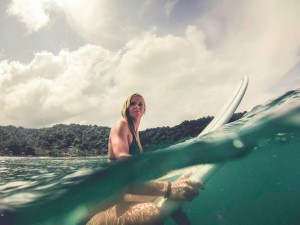
    Enjoying the warm water and friendly waves in Jaco .
    Enjoying the warm water and friendly waves in Jacó Beach.
    One of many colorful characters in Jaco.
    One of many colorful characters in Jacó.

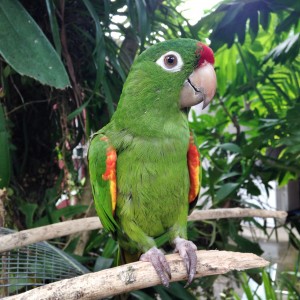
    Just 25km/15 miles North of Jacó you’ll find Carara National Park, a protected tropical rainforest, which has one of the biggest wild populations of colorful scarlet macaws. It is not just a heaven for bird lovers. The park is home to some of the country’s largest American crocodiles, sloths relaxing high up in the trees, different monkeys, frogs and birds.

    One of the country’s most famous (and smallest) parks, Manuel Antonio, is located about 65 km/40 miles South of Playa Jacó. Exploring the lush green rainforest and remote beaches on the many trails, you will easily spot mammals like lazy sloths and cute squirrel monkeys as well as frogs, iguanas and many kinds of birds.
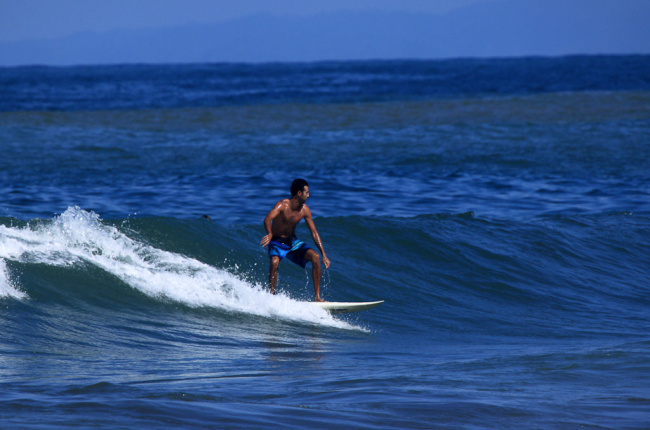
    Jaco has consistent waves for all levels year-round.
    Jacó Beach has consistent waves for all levels year-round.

     Jacó Beach is not only surf. Close to the town (and the school) you can go zip-lining, take a dip in watefall ponds, enjoy the nightlife, go rafting or just sit back, relax and enjoy a cold drink in the tropical setting.

    Academia Tica recommends that you try a bit of both locations and experience all the differences in culture, people, nature and just the general town dynamic. This will defninetively help you get a more integral view of what Costa Rica is, always with the same quality of Spanish tuition!
  • Las Cataratas – A day trip to the waterfalls

    Las Cataratas – A day trip to the waterfalls

    One Friday morning in Jacó Beach: Our group of seven Academia Tica students was being picked up in front of the apartments by Alan, our tour guide for the day. A 45 minutes drive southbound along the coast led us to the beginning of a narrow path through private farmland. First we passed chicken and horses, then the trail continued through the forest, crossing some little streams. Finally we reached the waterfall that made its way down through the jungle like a stairway for giants. Beautiful to see…and now what? I thought the hike would continue to the other ones – since the only thing I knew about the waterfalls back then was: there are at least 3 of them. And it did, just not in the way I expected. Alan began to climb up the rock wall beside the waterfall. We all watched him disappear as he jumped into the pool above. So we left our things at the bottom and followed him up. The second waterfall filled a nice deep pool where some of us dipped in (or in my case: half accidently slipped in). The others were already on their way up higher.

    “Once you are up there, the only way down is to jump!” Alan pointed out to us with a provocative twinkle in his eyes. Hesitating and still not quite sure about jumping down the not entirely vertical rock face, I climbed up next to the waterfall holding on to roots and little ledges. Once up there you could see the third and fourth waterfall with their round pools caved out of the dark rock around. The view down into the jungle was amazing! After another swim in the refreshing clear pools and a little massage of the top one of the waterfalls, it was time for the way back down.

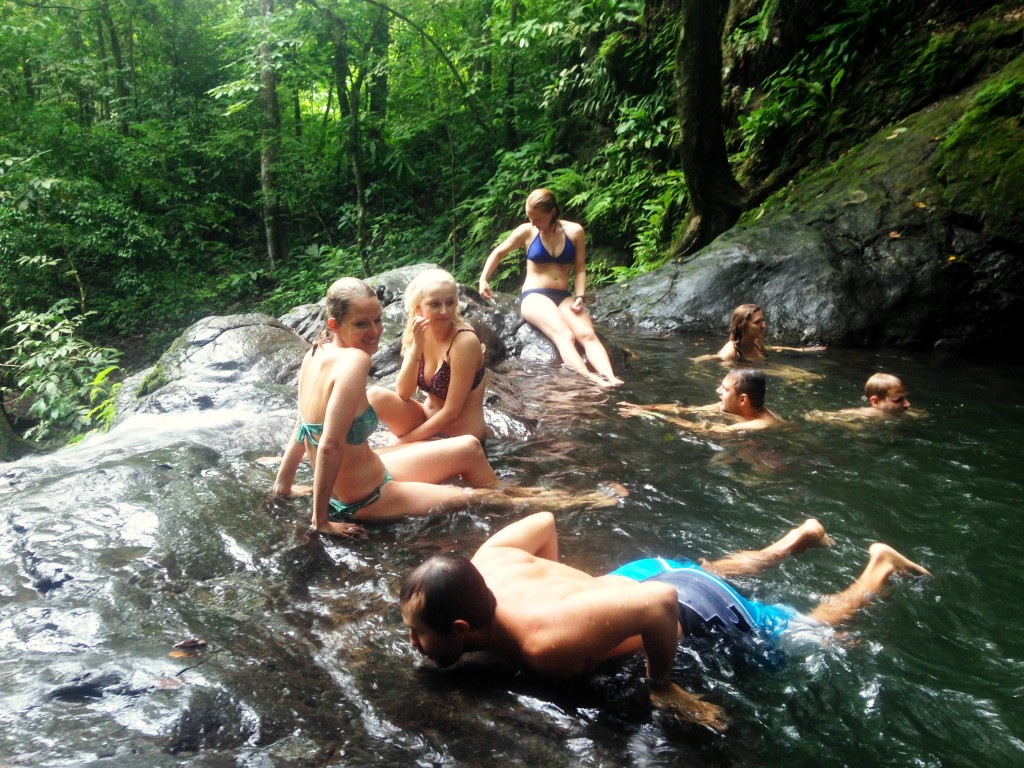
    Academia Tica students relaxing in the refreshing pool between two waterfalls.
    Academia Tica students relaxing in the refreshing pool between two waterfalls.

    Jumping from the upper waterfall was really fun. One by one we climbed to a spot where you could just let yourself fall into the pool a few meters beneath. The more than 5 meter jump into the last pool was a bit more thrilling. You had to stand on a little ledge where only your heels could fit and from that point jump forward since the rocks were not that steep. But we all did it – there was no other way, right? At this point big respect for Bob, one of the students in his seventies, who enjoyed it as much as everyone else! Full of adrenaline some of us jumped over and over again while the others were relaxing in the pool or tried (and partly succeeded) climbing up beneath the waterfall not being able to see where your hands could grip since the water kept lashing down onto your face.

    Perfectly content and definitely with an unforgettable experience more we later made our way back to Jacó. What a fun and unique day.

    ¡PURA VIDA!

    Cataratas
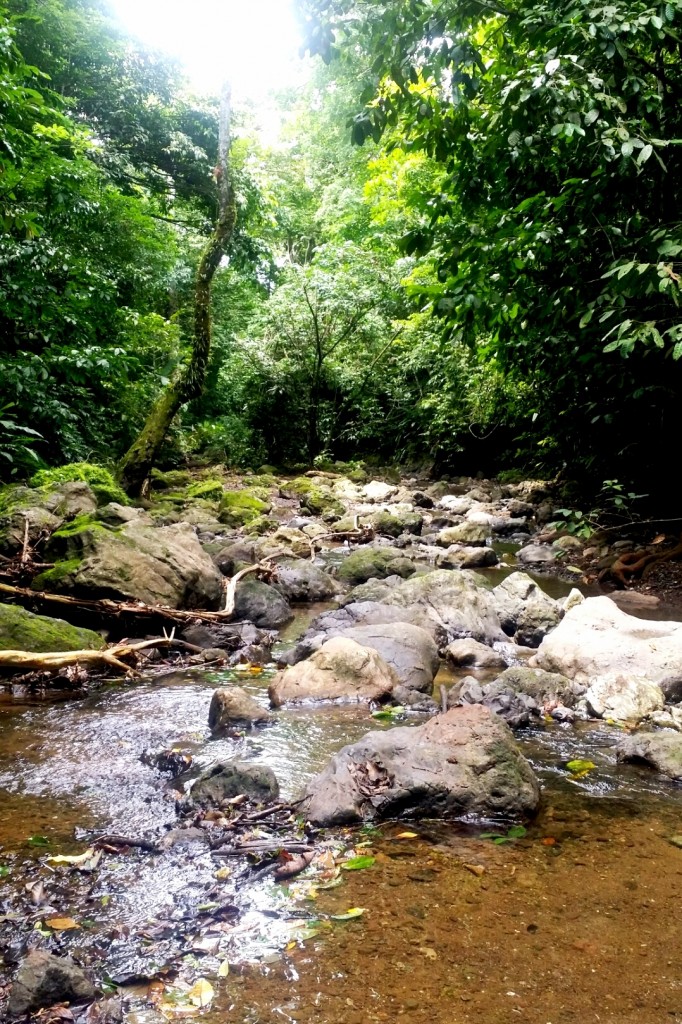
    Fresh clear water making its ways through the forest at “Las Cataratas Las Pilas” near Parrita.

    – Susanna Kowalzik


  • A bittersweet tour of chocolate

    A bittersweet tour of chocolate

    As I tentatively sip a watery concoction of cacao, almonds and chili, the possibility that this bitter-spicy beverage is even a form of chocolate seems remote, let alone that under my crinkled nose froths the ancient precursor to all chocolate as we know and love it.

    But history is a lot like taste — surprising, born of the bitter stuff and prone to unlikely combinations. Chocolate makes a great case study. While the chocolate we know today is more closely associated with European machines, West African soils and global appetites, the origins of cacao are in preColombian Latin America, where it has been grown, revered and served unsweetened for at least a millennium.

    On a recent day at Sibú Chocolate, an artesanal chocolatier and cafeteria located a short drive from Academia Tica Coronado, most of us discretely push aside the little cups filled with Montezuma’s spicy recipe for orgiastic fortitude, eyes fastening instead on a selection of truffles, each like a tiny sculpture molded to exacting specifications artfully arranged on gleaming white plates.

    But there is to be no gobbling of the gourmet chocolate on this tour. Restraint reigns as we listen to Julio Fernandez, co-founder of Sibú and Costa Rican historian, deliver an in-depth lecture. He prompts us to try each truffle as his story touches upon its origins. We are thousands of years into the story of chocolate before a Dutch chemist figures out how to produce it in solid form, like those so temptingly arranged on the table before us. Fernandez enlivens this long story with artifacts arranged all over Sibú’s garden cafeteria: from sticks and stone mortars to baroque oil paintings, WWII pin-ups and some chocolate-flavored product picked up at a local supermarket, for strictly anthropological purposes, of course.

    “This is not chocolate,” Fernandez shakes his head disapprovingly as he holds up the plastic bag. This gesture becomes more frequent as his narration moves into the 20th century, when global demand turned more and more chocolate into product.

    Founded by Fernandez and his American partner George Soriano, Sibú goes against this grain. “The (Sibu) concept is bean-to-gourmet-bar, and it has quite a few benefits. With higher-quality, handmade cacao, Soriano says he can ask a higher price and fairly pay farmers,” explained a recent report in the Tico Times.

    The eight different varieties of chocolate we try during the tour all come from cacao beans grown at a single organic plantation on the Caribbean coast. The aim is to be uniquely sustainable while crafting flavors that are uniquely Costa Rican. Fernandez says Tico chocolate has a bolder, more bitter taste than African chocolate, though it is less resistant to pests. Despite their cutesy names, like “frosty pod rot” or “witch broom,” certain molds have led to the near collapse of the cacao industry in Costa Rica over the last thirty years, causing farmers to turn to livestock raising and other forms of agriculture, accelerating deforestation. (Cacao thrives in the shade and can be grown in a biologically diverse ecosystem, though some research suggests that these benefits can be relatively short-lived when coupled with pressure to produce high yields every season.)

    In 1975, three years before the first frosty pod rot epidemics wiped out whole plantations on the Pacific Coast, Costa Rica produced nearly 7,000 tons of cacao beans. By 2012, that had dropped to just 700 tons, a 90% decrease. Meanwhile, production in West Africa’s Cote D’Ivoire increased a staggering 575 percent during the same 37-year period, according to statistics from the United Nations Food and Agriculture Administration. The human cost accompanying Africa’s cacao boom is incalculable, with nearly 820,000 child laborers working on Cote D’Ivoire cacao plantations.

    -Emily Jo Cureton

    Academia Tica students enjoy some coffee after a tour of Sibù Chocolate in Heredia.
    Academia Tica students enjoy some coffee after a tour of Sibù Chocolate in Heredia.
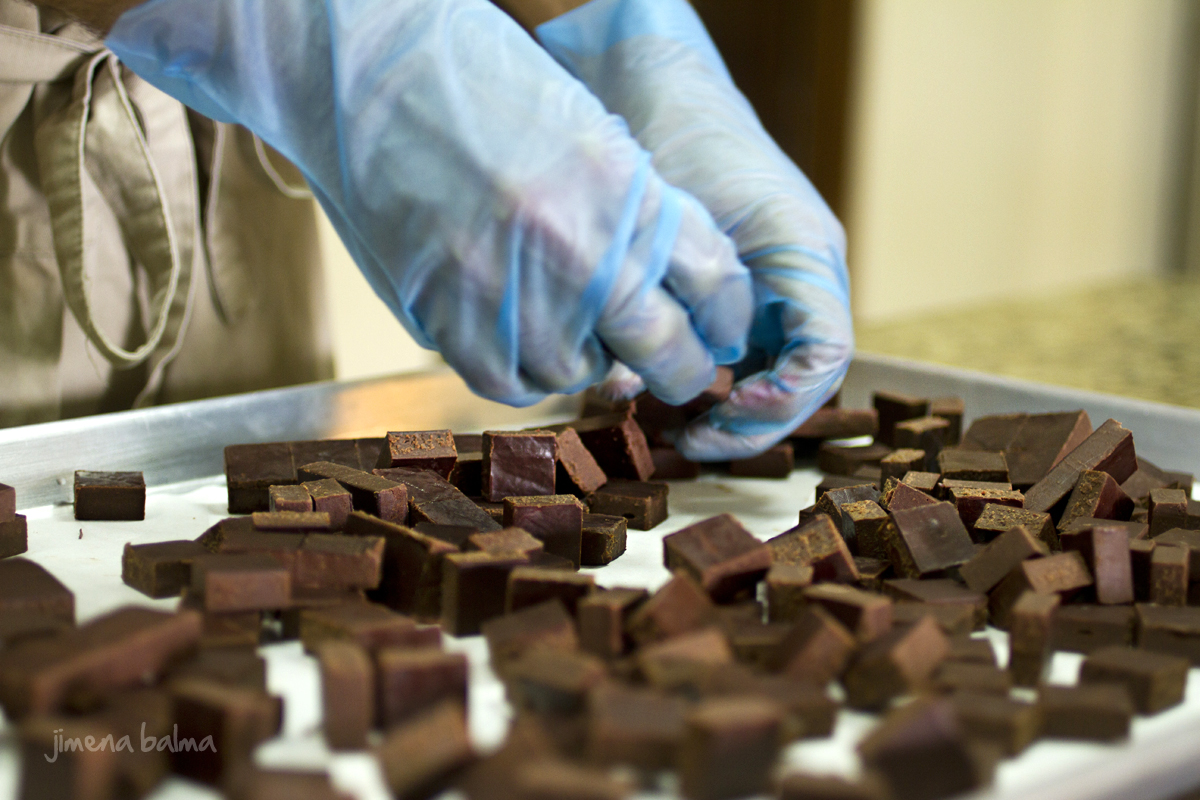
    Organic chocolate being prepared at Sibú in Heredia, Costa Rica.
    Organic chocolate being prepared at Sibú in Heredia, Costa Rica.
  • Changing face in Escazú

    Changing face in Escazú

    When we pull up to his Escazú home, Gerardo Montoya hits play.

    Parade sounds fill this sleepy neighborhood in the hills overlooking Costa Rica’s capital city. Crashing cymbals and snare drums punch off time as we walk down the driveway towards a garage workshop where our host awaits, dancing among the monsters he’s created, many of them large enough to swallow a man whole.

    He cuts the music and announces:

    “Meet my second family!”

    There is el Chupacabra the blood sucking goat killer, just chilling next to Martina the spunky abuela. There are grinning diablos crowding long-nosed brujas, witches in cahoots with their equally hideous boyfriends, the brujos. There’s the hot pink-cheeked Rosita, a fat Spanish madam who spends most of her time with the hairless, tirelessly ambitious el Calvo. There’s la Segua, half beautiful woman, half dead horse. Her hobbies include hanging around water and scaring the pants back on unfaithful husbands. There’s Pancho the humble rancher, El Chino the racial stereotype and in the back there is Gerardo, a mask modeled after its maker, the likeness uncanny.

    The “real” Gerardo Montoya beams as he explains the family history. His grandfather was Pedro Arias, one of the most famous mid-century Costa Rican mask-makers or mascareros, who defined an aesthetic style still used all over the country to make these paper mâché  “payasos,” beloved guests at every popular festival or celebration, prone to spontaneous dancing and the chasing of children.

    Montoya founded this workshop about 20 years ago, after hard times drove the family to sell its farmland in Escazú. Property values promptly sky-rocketed. Montoya has said within three years the German investor who bought that two hectare property was offered more than triple the amount he paid. This kind of story is typical of the rapid transformation taking place in this increasingly affluent cantón, 8 kilometers from central San José.

    To get to the mask workshop, we first pass “new” Escazú’s towering condominiums, its gleaming skyscrapers and a colossal shopping mall. We don’t stop at Hooter’s, nor at the liquor store with an LED sign called La Bruja. We ascend narrow residential streets lined with locked gates, shiny cars and for sale signs featuring swimming pools. Near the end we pass an historic Catholic Church, a mural dedicated to cattle ranching and a 100-year-old adobe house where legend has it a real witch once lived. Finally, we climb the steepest grade yet, toward the cloud forests of Pico Blanca. Half-way up we arrive at Montoya’s home and workshop, 200 meters past the water treatment plant where he now works as a technician.

    That’s his day job, but “…This is happiness for me,” he says, motioning to the masks.

    “To sell a mask would be like selling a son.”

    Though, he does have seven of them. (Sons, that is.) Two have learned to make the traditional masks, using clay to create molds that are then covered in strips of newspaper soaked in yucca gum, left to dry, mounted on wooden or metal frames and painted. It´s a month-long process before they are ready. Montoya doesn’t sell the masks, instead renting them to municipalities for popular festivals, which abound in Costa Rica. Famous for exemplifying the Central Valley style, Montoya’s masks were even used during the 1998 presidential inauguration of Miguel Angel Rodríguez.

    At our tour Pedro Montoya, one of the seven sons, disappears under the skirt of a giganta, her gaudily made-up face and blonde hair a parody of a colonial Spanish dueña. He begins to dance like there’s nothing at all precarious about this situation, flirting shamelessly with our driver and facilities manager, Ricardo.

    Next we assume some strange forms ourselves.

    Upon reflection, wearing that mask and dancing like a maniac in Montoya’s driveway reminds me of learning Spanish through immersion. The giddiness and the sweat. The sense that whatever I want to convey is distorted by what I can convey. Feeling foolish and realizing that is actually kind of fun. The exaggerated gestures and lack of subtlety. The smiles and the laughter. The art of not taking oneself too seriously.

    -Emily Jo Cureton

    Academia Tica students masquerade at Montoya's Escazú studio, home to traditional Costa Rican masks  used for festivals around the country.
    Academia Tica students masquerade at Montoya’s Escazú studio, home to traditional Costa Rican masks used for festivals around the country.