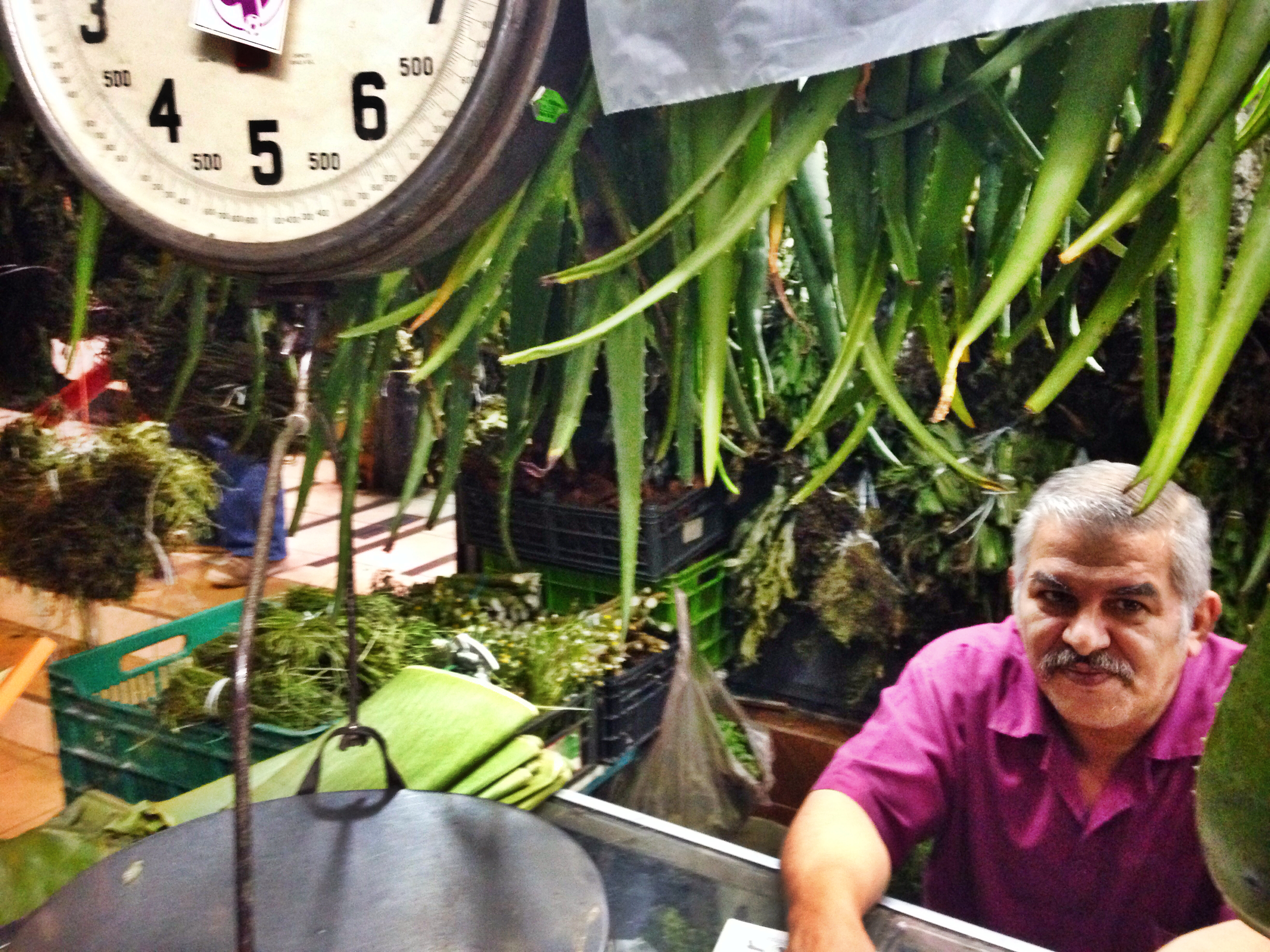
The Central Market of San José is a feast for the senses, filled with fresh fruits, veggies, flowers, medicinal plants, clothes, souvenirs, seafood, pets, handicrafts, you name it! Before devling into these bustling aisles during a recent class excursion, Prof Mireya gave a spiel about the capital’s commerical heart:
“The Mercado Central is located between Avenidas 0 and 1 and Calles 6 and 8. It was established in 1880 and declared national patrimony in 1995. Part of the building dates to the end of the 1800s and part was built in the 1940s. The market’s narrow aisles are always full of life, with their own manifestations of popular culture, from typical food and handicrafts, to herbs and ways of speaking.”
“Està ubicado entre las avenidas 0 y 1 y las calles 6 y 8. Fue establecido en 1880 y declarado patrimonio nacional en 1995. Una parte de su edificio data, precisamente, de finales del siglo XIX y otra fue construida en los años 40 del siglo pasado. Sus angostos pasillos siempre están llenos de vida, con manifestaciones propias de la cultura popular costarricense como la gastronomía, la artesanìa, la herbolaria, y también las formas de hablar.”
Just a few of the souvenirs at the Mercado Central in San Jose, Costa Rica.
The hand-painted sign showing two bridled horses does not point towards a fancy place. Turning down this stone driveway off the main road through Las Nubes will not deliver you to a state-of-the-art equine training facility. Nor are these lush pastures described in any Lonely Planet guidebooks. Yet, the animals grazing these hills speak volumes about the culture of Costa Rica’s Central Valley, where horses are not just historical throwbacks but remain essential for work, getting around and showing off in distinctly Tico style.
About 5 km from the school “Coronado a Caballo” offers informal, very affordable “cabalgatas” ( trail rides), based out of a modest stable with 50 or so well-cared-for horses, frequented by Ticos much more than foreign tourists. The Costa Rican saddle horses raised here are colloquially known as “criollos,” descended from Spanish and Peruvian breeds. Some are trained to make impressive, dance-like movements, with dramatic knees and dropped noses, like someone who sees a spider in every step. The trail horses are less flashy, with smooth sure-footed gaits even in rough terrain.
The hills and farms east of our Coronado campus certainly qualify. While only a short distance from the most densely populated and urbanized cities in the country, much of the highlands are still only accessibly by horse, motorbike or 4×4 vehicle. The road to Las Nubes disintegrates into skeins of rock and mud about 10 km from the school as it passes near the edge of Braulio Carrillo National Park.
Horseback riding provides unique panoramic views of the Central Valley below, the Cordillera Central mountains and cloud forests above. Plus that sense of freedom and possibility that for whatever reason, only seems to come when you’re a meter off the ground on the back of a trusty horse.
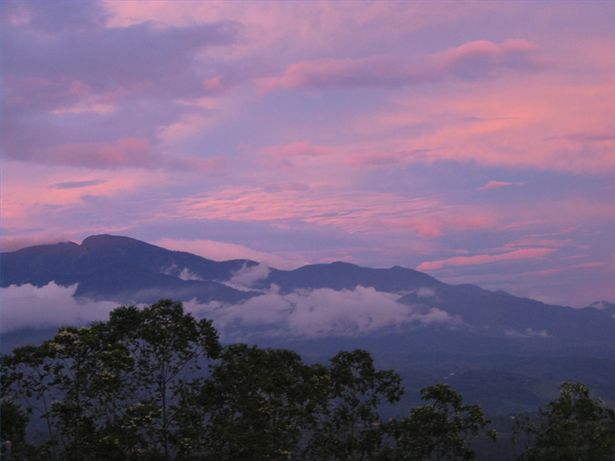
The light and the land in Coronado, San Jose, Costa Rica.
Up the hill from Academia Tica Coronado a cozy little place by the side of the road serves up about the freshest trout imaginable, Tico style.
At this family-run “trucheria,” (trucha means trout), you can catch your own lunch from a backyard pond. Luckily professionals take over from there. Have a seat in the rustic dining room as the fish is seasoned and grilled to perfection, then served with rice, fries, plantains and salad. To find this authentic cultural gem, take the bus to Las Nubes to the very last stop in Cascajal, then keep going up the road by foot. This 3km walk wends through beautiful pastures with sweeping views of the Central Valley. Look for reassuring signs that say “Bella Vista Trucheria, XX metros.” You have arrived when a sign in a driveway on the left that says, “Bienvenidos” with a giant fish painting. Open weekends and holidays.
This sign spells out the philosophy at Bella Vista Trucheria in Coronado.Fresh trout served at a homespun restaurant near Academia Tica Coronado.
As I tentatively sip a watery concoction of cacao, almonds and chili, the possibility that this bitter-spicy beverage is even a form of chocolate seems remote, let alone that under my crinkled nose froths the ancient precursor to all chocolate as we know and love it.
But history is a lot like taste — surprising, born of the bitter stuff and prone to unlikely combinations. Chocolate makes a great case study. While the chocolate we know today is more closely associated with European machines, West African soils and global appetites, the origins of cacao are in preColombian Latin America, where it has been grown, revered and served unsweetened for at least a millennium.
On a recent day at Sibú Chocolate, an artesanal chocolatier and cafeteria located a short drive from Academia Tica Coronado, most of us discretely push aside the little cups filled with Montezuma’s spicy recipe for orgiastic fortitude, eyes fastening instead on a selection of truffles, each like a tiny sculpture molded to exacting specifications artfully arranged on gleaming white plates.
But there is to be no gobbling of the gourmet chocolate on this tour. Restraint reigns as we listen to Julio Fernandez, co-founder of Sibú and Costa Rican historian, deliver an in-depth lecture. He prompts us to try each truffle as his story touches upon its origins. We are thousands of years into the story of chocolate before a Dutch chemist figures out how to produce it in solid form, like those so temptingly arranged on the table before us. Fernandez enlivens this long story with artifacts arranged all over Sibú’s garden cafeteria: from sticks and stone mortars to baroque oil paintings, WWII pin-ups and some chocolate-flavored product picked up at a local supermarket, for strictly anthropological purposes, of course.
“This is not chocolate,” Fernandez shakes his head disapprovingly as he holds up the plastic bag. This gesture becomes more frequent as his narration moves into the 20th century, when global demand turned more and more chocolate into product.
Founded by Fernandez and his American partner George Soriano, Sibú goes against this grain. “The (Sibu) concept is bean-to-gourmet-bar, and it has quite a few benefits. With higher-quality, handmade cacao, Soriano says he can ask a higher price and fairly pay farmers,” explained a recent report in the Tico Times.
The eight different varieties of chocolate we try during the tour all come from cacao beans grown at a single organic plantation on the Caribbean coast. The aim is to be uniquely sustainable while crafting flavors that are uniquely Costa Rican. Fernandez says Tico chocolate has a bolder, more bitter taste than African chocolate, though it is less resistant to pests. Despite their cutesy names, like “frosty pod rot” or “witch broom,” certain molds have led to the near collapse of the cacao industry in Costa Rica over the last thirty years, causing farmers to turn to livestock raising and other forms of agriculture, accelerating deforestation. (Cacao thrives in the shade and can be grown in a biologically diverse ecosystem, though some research suggests that these benefits can be relatively short-lived when coupled with pressure to produce high yields every season.)
In 1975, three years before the first frosty pod rot epidemics wiped out whole plantations on the Pacific Coast, Costa Rica produced nearly 7,000 tons of cacao beans. By 2012, that had dropped to just 700 tons, a 90% decrease. Meanwhile, production in West Africa’s Cote D’Ivoire increased a staggering 575 percent during the same 37-year period, according to statistics from the United Nations Food and Agriculture Administration. The human cost accompanying Africa’s cacao boom is incalculable, with nearly 820,000 child laborers working on Cote D’Ivoire cacao plantations.
-Emily Jo Cureton
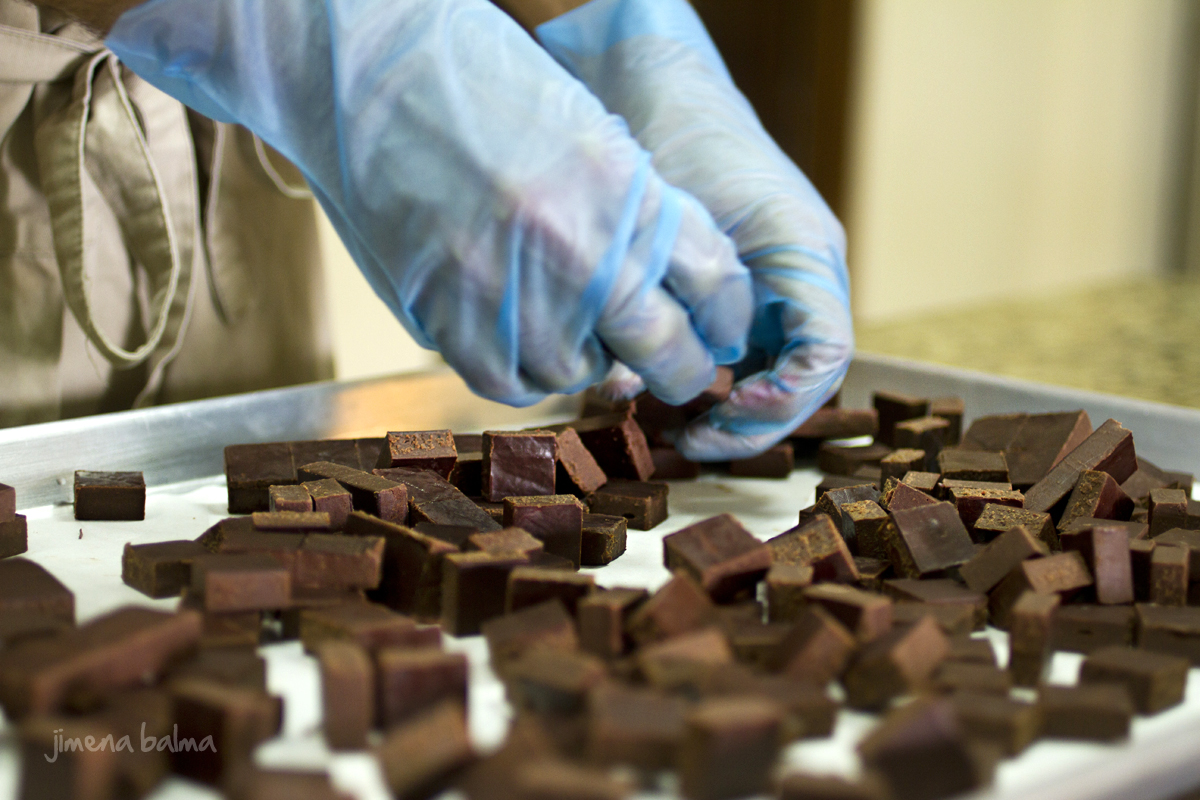
Academia Tica students enjoy some coffee after a tour of Sibù Chocolate in Heredia.Organic chocolate being prepared at Sibú in Heredia, Costa Rica.