Up the hill from Academia Tica Coronado a cozy little place by the side of the road serves up about the freshest trout imaginable, Tico style.
At this family-run “trucheria,” (trucha means trout), you can catch your own lunch from a backyard pond. Luckily professionals take over from there. Have a seat in the rustic dining room as the fish is seasoned and grilled to perfection, then served with rice, fries, plantains and salad. To find this authentic cultural gem, take the bus to Las Nubes to the very last stop in Cascajal, then keep going up the road by foot. This 3km walk wends through beautiful pastures with sweeping views of the Central Valley. Look for reassuring signs that say “Bella Vista Trucheria, XX metros.” You have arrived when a sign in a driveway on the left that says, “Bienvenidos” with a giant fish painting. Open weekends and holidays.
This sign spells out the philosophy at Bella Vista Trucheria in Coronado.Fresh trout served at a homespun restaurant near Academia Tica Coronado.
As I tentatively sip a watery concoction of cacao, almonds and chili, the possibility that this bitter-spicy beverage is even a form of chocolate seems remote, let alone that under my crinkled nose froths the ancient precursor to all chocolate as we know and love it.
But history is a lot like taste — surprising, born of the bitter stuff and prone to unlikely combinations. Chocolate makes a great case study. While the chocolate we know today is more closely associated with European machines, West African soils and global appetites, the origins of cacao are in preColombian Latin America, where it has been grown, revered and served unsweetened for at least a millennium.
On a recent day at Sibú Chocolate, an artesanal chocolatier and cafeteria located a short drive from Academia Tica Coronado, most of us discretely push aside the little cups filled with Montezuma’s spicy recipe for orgiastic fortitude, eyes fastening instead on a selection of truffles, each like a tiny sculpture molded to exacting specifications artfully arranged on gleaming white plates.
But there is to be no gobbling of the gourmet chocolate on this tour. Restraint reigns as we listen to Julio Fernandez, co-founder of Sibú and Costa Rican historian, deliver an in-depth lecture. He prompts us to try each truffle as his story touches upon its origins. We are thousands of years into the story of chocolate before a Dutch chemist figures out how to produce it in solid form, like those so temptingly arranged on the table before us. Fernandez enlivens this long story with artifacts arranged all over Sibú’s garden cafeteria: from sticks and stone mortars to baroque oil paintings, WWII pin-ups and some chocolate-flavored product picked up at a local supermarket, for strictly anthropological purposes, of course.
“This is not chocolate,” Fernandez shakes his head disapprovingly as he holds up the plastic bag. This gesture becomes more frequent as his narration moves into the 20th century, when global demand turned more and more chocolate into product.
Founded by Fernandez and his American partner George Soriano, Sibú goes against this grain. “The (Sibu) concept is bean-to-gourmet-bar, and it has quite a few benefits. With higher-quality, handmade cacao, Soriano says he can ask a higher price and fairly pay farmers,” explained a recent report in the Tico Times.
The eight different varieties of chocolate we try during the tour all come from cacao beans grown at a single organic plantation on the Caribbean coast. The aim is to be uniquely sustainable while crafting flavors that are uniquely Costa Rican. Fernandez says Tico chocolate has a bolder, more bitter taste than African chocolate, though it is less resistant to pests. Despite their cutesy names, like “frosty pod rot” or “witch broom,” certain molds have led to the near collapse of the cacao industry in Costa Rica over the last thirty years, causing farmers to turn to livestock raising and other forms of agriculture, accelerating deforestation. (Cacao thrives in the shade and can be grown in a biologically diverse ecosystem, though some research suggests that these benefits can be relatively short-lived when coupled with pressure to produce high yields every season.)
In 1975, three years before the first frosty pod rot epidemics wiped out whole plantations on the Pacific Coast, Costa Rica produced nearly 7,000 tons of cacao beans. By 2012, that had dropped to just 700 tons, a 90% decrease. Meanwhile, production in West Africa’s Cote D’Ivoire increased a staggering 575 percent during the same 37-year period, according to statistics from the United Nations Food and Agriculture Administration. The human cost accompanying Africa’s cacao boom is incalculable, with nearly 820,000 child laborers working on Cote D’Ivoire cacao plantations.
-Emily Jo Cureton
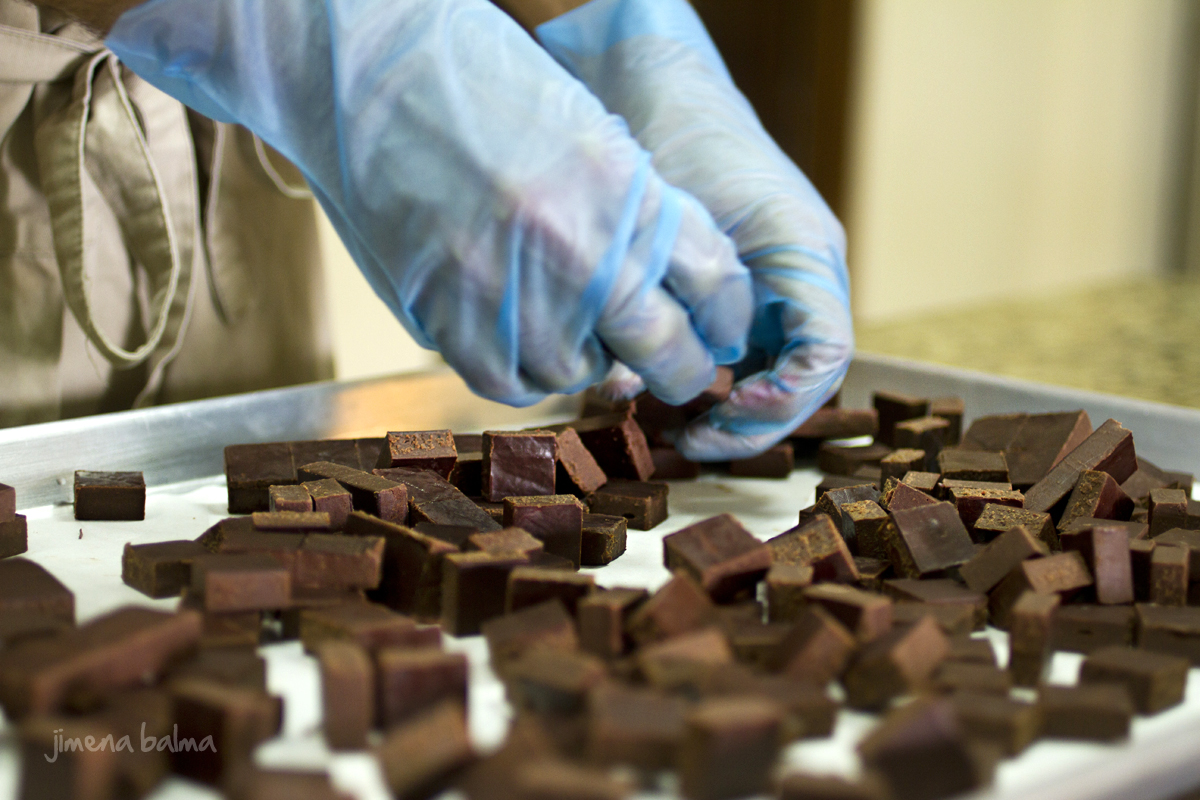
Academia Tica students enjoy some coffee after a tour of Sibù Chocolate in Heredia.Organic chocolate being prepared at Sibú in Heredia, Costa Rica.
We loaded our plates with fresh empañadas, cheesy tortillas and sweet chorreadas, unwrapping huge banana leaves to reveal steaming tamales filled with veggies and meat. We ohhed, ahhed and salivated over the tamal asado, a sticky sweet cornbread that frankly put me over the edge of satisfied, too full to try any more typical Costa Rican dishes made from maize, the star ingredient in this Tuesday tasting class.
When we look at any Costa Rican table today, chances are at least one thing on it was born of corn, that versatile staple vital to life all over the Americas since time immemorial. If we were to dig in the gooey sediment of Guanacaste lakes, we would uncover 5,000 year old maize pollens. If we dove to the bottom of Arenal Lagoon, we might resurface with charred cobs from 2000 BC. But even as technology like carbon-dating and genetic sequencing shuck the history of modern maize, its origins remain mysterious and its future uncertain.
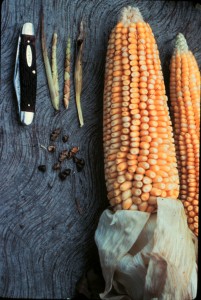
Modern corn with its diminutive ancestor, teosinte.
Most scholars agree maize was domesticated between 7,500 and 12,000 years ago in Mexico. Its nearest wild relative is a grass species called teosinte, in which each teeny tiny kernel is enclosed in a hard shell. It remains unclear how prehistoric Americans managed to cultivate the starchy stuff of tamales from this unpromising ancestor, itself barely a mouthful, hardly worth the effort for even the most industrious omnivore.
Mankind’s unlikely mastery of maize has far from run its course. In 2013, some 32 percent of corn grown in the entire world was genetically modified in some way, meaning it contained genes that were altered by humans with the intention of making the crop more productive, resistent to drought, bugs and blights, or some combination of these. About 90 percent of corn grown in the United States that year came from GM seeds, which are typically patented by the multinational corporations that developed them.
Because of patents, farmers can not legally use GM seeds without buying new ones every single season. For example, Monsanto, one of the world’s biggest and most profitable GMO producers, pursued 145 lawsuits relating to patent control between 1997 and 2012.
We need not root around very long to get an earful about GMOs. Many say patent laws foster monopolies that put small farmers out of business while monocultures (single crop plantations) are underming soil longevity and overall ecosystem health as they wreak unintended havoc on human health, too. Others say that GMOs are a necessary innovation in agriculture, one that allows us to use less while producing more, developed in response to ballooning populations and dwindling water supplies.
The debate over GM corn is a fiery one in a country where extensive agriculture and extremely high biological diversity coexist. Currently, Costa Rica does not produce GM corn, (however, GM cotton, soybeans, pineapple and banana plots are grown here). This exclusion could change soon. In Jan. 2013 a subsidiary of Monsanto gained approval from Costa Rica’s National Biosecurity Technical Commission to grow corn, sparking mass protests and a legal appeal, which put the project on hold until Costa Rica’s Supreme Court reviews its constitutionality. By 2013, 66 out of 82 cantons in Costa Rica had passed laws prohibiting GMOs in some way. Still, no national law backs this popular majority and GMO projects are ultimately approved or denied by the feds on a case by case basis.
The introduction of GM corn is especially high stakes because unlike soybeans and cotton, corn pollinates on the whims of the wind. Many believe GM seeds will contaminate native fields and make it very difficult for farmers to grow heritage crops.
But when I bit into the chorreadas at Tuesday’s class, I tasted neither the history of civilization nor its fate, just the indescribable sweetness of American corn, smothered in sour cream.
Studying takes a turn for the delicious at Academia Tica’s fruit tasting class, where we sample some of Costa Rica’s most sumptuous offerings. After an hour at this mouth-watering table we know our mangos from our mangas, our guanabanas from our guabas, our nances from our elbows.
In Costa Rica fruit is a USD $1.5 billion a year industry, accounting for 84 percent of the country’s agriculture, according to statistics from the United Nations Food and Agriculture Organization. Pineapple production in particular increased 42% from 2009-2013, mostly exports grown on huge plantations.
Still, locally-grown small-scale fruit is easy to find at outdoor markets and roadsides. Fruity drinks and smoothies (called naturales and batidos respectively) can be found virtually everywhere food and drinks are sold. Local chains for these kind of beverages have flourished over the last couple of years.
Because it has rich volcanic soils, tropical climates and temperate zones, Costa Rica produces an astonishing variety of fruits, many indigenous to Central America and many imported from Asia. At this Tuesday’s tasing class, students try just a smattering of what’s in season.
Guaba – Commonly known as a the the ice-cream bean, large green pods contain black seeds with a thick white juicy pulp that tastes slightly like vanilla ice cream
Granadilla – Known as passionfruit in the English-speaking world. Easily peeled by hand, the edible black seeds are coated in a slippery, brain-like goo, which smells as sweet as it tastes. Its tangy cousin the maracuya is more popular for drinks and smoothies.
Manga – the ultimate tropical treat imported to this hemisphere after thousands of years of cultivation in Asia, prolific in Costa Rica and much of Latin America, sweet, often fibrous with a stone like center.
Mango – Small green cousins of larger, riper mangas
Limon dulce – Sweet limes are another native of Asia. The flavor is sweet and mild, but retains the essence of lime. Less acidic than most citrus, can be bitten right into but more popular in drinks.
Nances – Strong-smelling cherry-like fruits that are popularly used in regional wine called vino de nances.
Pina – Pineapple is Costa Rica’s fastest growing export. Delicious but when produced on such a large scale, environmentally dubious.
Sandia – Watermelon is prolific in Costa Rica. Originally from Africa and actually considered by botanists to be a special kind of berry with a hard rind.
Papaya – A native of Central American, papaya has fed its inhabitants for thousands of years. The sweet orange flesh is also known to have numerous medicinal applications.
Carambola – Descriptively known as the starfruit for its shape, this native of Asia has a punchy, acidic flavor.
Other fruits common in Costa Rica include the dietary staples plantains and avocados.
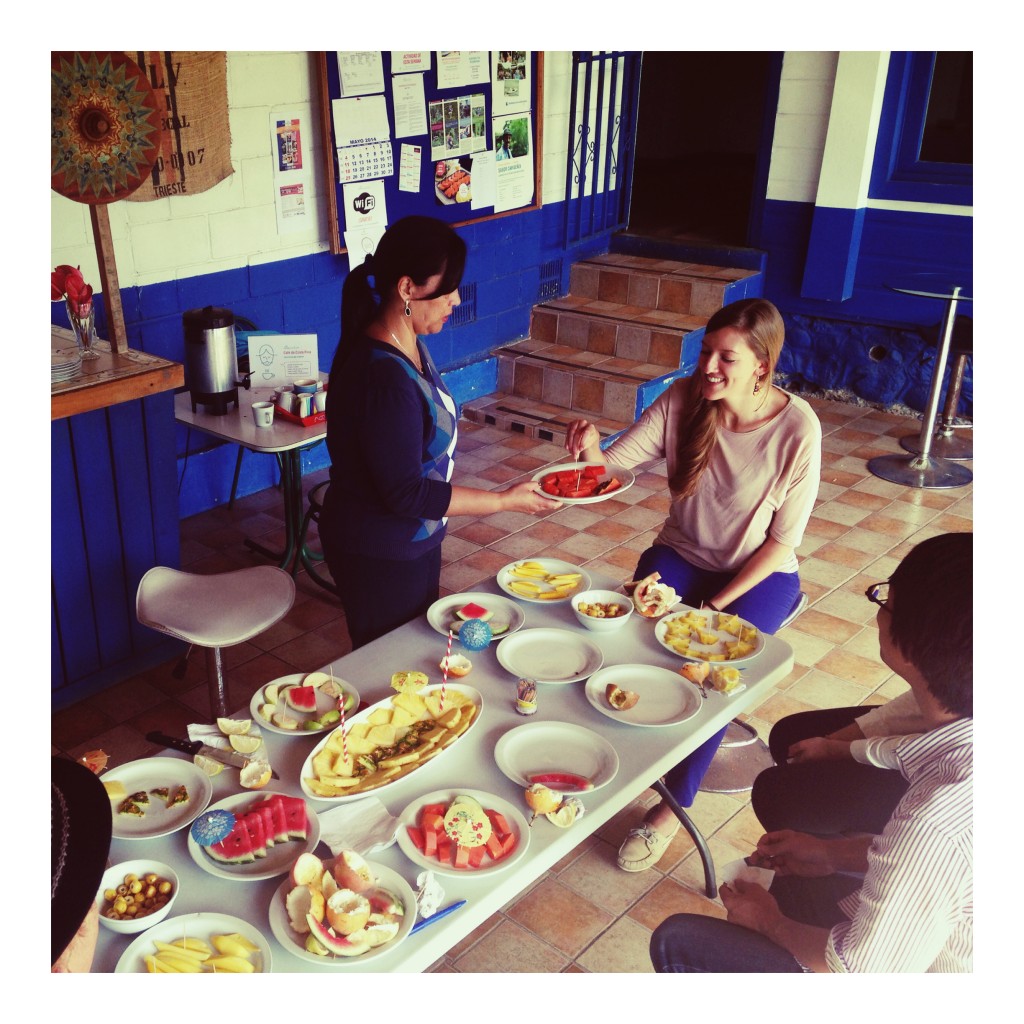
Academia Tica students sample the fruits of Costa Rica — diverse, abundant and so tasty!