A few of Academia Tica’s most experienced instructors offered advice on how to begin the rewarding process of learning Spanish. With 65 years of teaching experience between them, we thought it worthwhile to share these kernels of wisdom with the world. Enjoy!
“The number one must for new students is simply wanting to study. Step two is actually studying, then studying, studying and studying some more. Finally, don’t just practice in the classroom, practice anytime you can with whomever you can, at the supermarket, with friends, colleagues or your host family.” -Elizabeth Gamboa
“If you want to learn you have to have an open mind, be willing to be surprised and not rationalize everything according to what you are already know. Really open your mind and admire what you are learning. Feel the language, feel the rhythm and let it flow.” – Santiago González
“It is very important to practice after class. You don’t even need another person to do this. Use a mirror and talk to yourself if you need to. Practice the structure and the grammar. It is not enough to only practice in class because you will forget things.” – Mireya Mora
The experts agree: hard work, openness and a good attitude are at the heart of learning anything new. But immersion might be the closest thing to a magic bullet for learning a language, along with committed teachers who actually care about your progress.
We loaded our plates with fresh empañadas, cheesy tortillas and sweet chorreadas, unwrapping huge banana leaves to reveal steaming tamales filled with veggies and meat. We ohhed, ahhed and salivated over the tamal asado, a sticky sweet cornbread that frankly put me over the edge of satisfied, too full to try any more typical Costa Rican dishes made from maize, the star ingredient in this Tuesday tasting class.
When we look at any Costa Rican table today, chances are at least one thing on it was born of corn, that versatile staple vital to life all over the Americas since time immemorial. If we were to dig in the gooey sediment of Guanacaste lakes, we would uncover 5,000 year old maize pollens. If we dove to the bottom of Arenal Lagoon, we might resurface with charred cobs from 2000 BC. But even as technology like carbon-dating and genetic sequencing shuck the history of modern maize, its origins remain mysterious and its future uncertain.
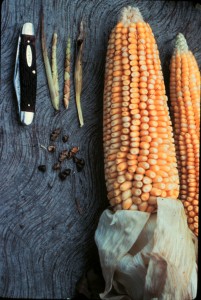
Modern corn with its diminutive ancestor, teosinte.
Most scholars agree maize was domesticated between 7,500 and 12,000 years ago in Mexico. Its nearest wild relative is a grass species called teosinte, in which each teeny tiny kernel is enclosed in a hard shell. It remains unclear how prehistoric Americans managed to cultivate the starchy stuff of tamales from this unpromising ancestor, itself barely a mouthful, hardly worth the effort for even the most industrious omnivore.
Mankind’s unlikely mastery of maize has far from run its course. In 2013, some 32 percent of corn grown in the entire world was genetically modified in some way, meaning it contained genes that were altered by humans with the intention of making the crop more productive, resistent to drought, bugs and blights, or some combination of these. About 90 percent of corn grown in the United States that year came from GM seeds, which are typically patented by the multinational corporations that developed them.
Because of patents, farmers can not legally use GM seeds without buying new ones every single season. For example, Monsanto, one of the world’s biggest and most profitable GMO producers, pursued 145 lawsuits relating to patent control between 1997 and 2012.
We need not root around very long to get an earful about GMOs. Many say patent laws foster monopolies that put small farmers out of business while monocultures (single crop plantations) are underming soil longevity and overall ecosystem health as they wreak unintended havoc on human health, too. Others say that GMOs are a necessary innovation in agriculture, one that allows us to use less while producing more, developed in response to ballooning populations and dwindling water supplies.
The debate over GM corn is a fiery one in a country where extensive agriculture and extremely high biological diversity coexist. Currently, Costa Rica does not produce GM corn, (however, GM cotton, soybeans, pineapple and banana plots are grown here). This exclusion could change soon. In Jan. 2013 a subsidiary of Monsanto gained approval from Costa Rica’s National Biosecurity Technical Commission to grow corn, sparking mass protests and a legal appeal, which put the project on hold until Costa Rica’s Supreme Court reviews its constitutionality. By 2013, 66 out of 82 cantons in Costa Rica had passed laws prohibiting GMOs in some way. Still, no national law backs this popular majority and GMO projects are ultimately approved or denied by the feds on a case by case basis.
The introduction of GM corn is especially high stakes because unlike soybeans and cotton, corn pollinates on the whims of the wind. Many believe GM seeds will contaminate native fields and make it very difficult for farmers to grow heritage crops.
But when I bit into the chorreadas at Tuesday’s class, I tasted neither the history of civilization nor its fate, just the indescribable sweetness of American corn, smothered in sour cream.
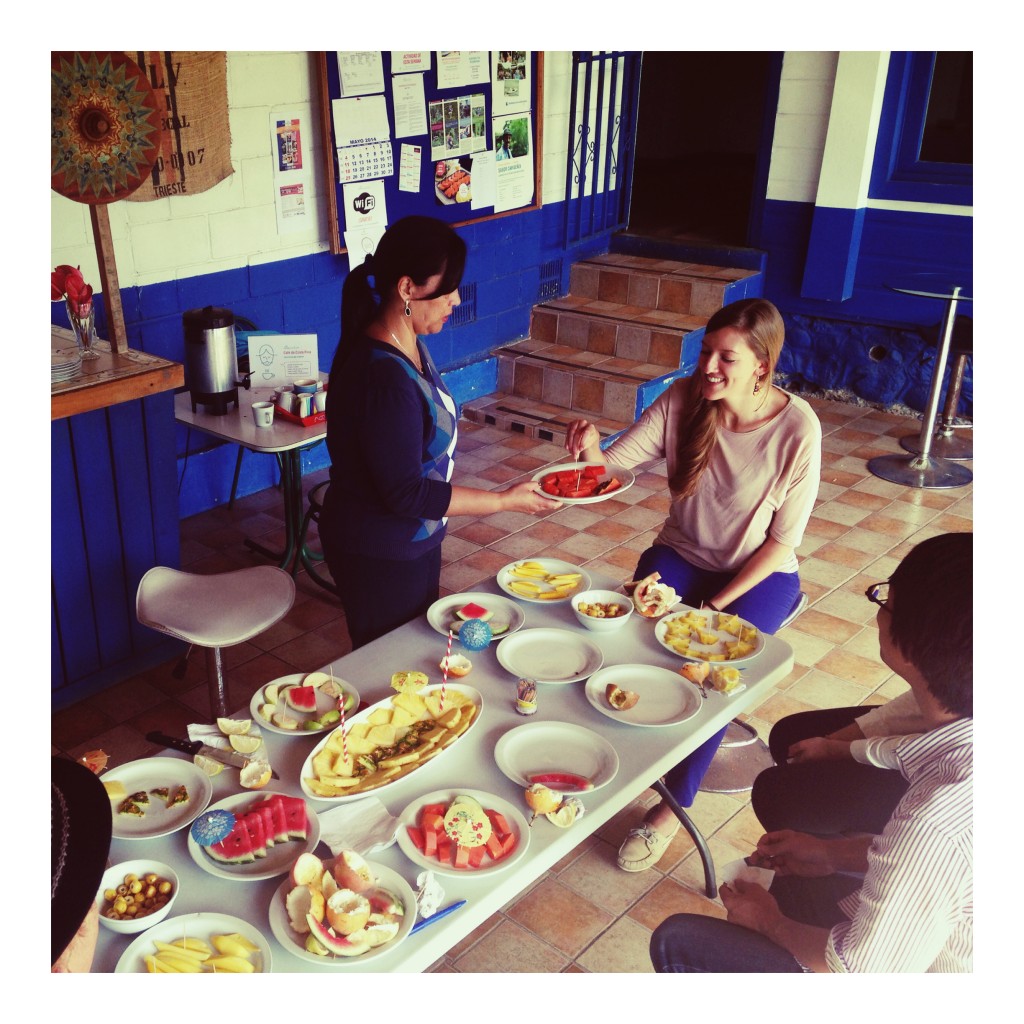
Studying takes a turn for the delicious at Academia Tica’s fruit tasting class, where we sample some of Costa Rica’s most sumptuous offerings. After an hour at this mouth-watering table we know our mangos from our mangas, our guanabanas from our guabas, our nances from our elbows.
In Costa Rica fruit is a USD $1.5 billion a year industry, accounting for 84 percent of the country’s agriculture, according to statistics from the United Nations Food and Agriculture Organization. Pineapple production in particular increased 42% from 2009-2013, mostly exports grown on huge plantations.
Still, locally-grown small-scale fruit is easy to find at outdoor markets and roadsides. Fruity drinks and smoothies (called naturales and batidos respectively) can be found virtually everywhere food and drinks are sold. Local chains for these kind of beverages have flourished over the last couple of years.
Because it has rich volcanic soils, tropical climates and temperate zones, Costa Rica produces an astonishing variety of fruits, many indigenous to Central America and many imported from Asia. At this Tuesday’s tasing class, students try just a smattering of what’s in season.
Guaba – Commonly known as a the the ice-cream bean, large green pods contain black seeds with a thick white juicy pulp that tastes slightly like vanilla ice cream
Granadilla – Known as passionfruit in the English-speaking world. Easily peeled by hand, the edible black seeds are coated in a slippery, brain-like goo, which smells as sweet as it tastes. Its tangy cousin the maracuya is more popular for drinks and smoothies.
Manga – the ultimate tropical treat imported to this hemisphere after thousands of years of cultivation in Asia, prolific in Costa Rica and much of Latin America, sweet, often fibrous with a stone like center.
Mango – Small green cousins of larger, riper mangas
Limon dulce – Sweet limes are another native of Asia. The flavor is sweet and mild, but retains the essence of lime. Less acidic than most citrus, can be bitten right into but more popular in drinks.
Nances – Strong-smelling cherry-like fruits that are popularly used in regional wine called vino de nances.
Pina – Pineapple is Costa Rica’s fastest growing export. Delicious but when produced on such a large scale, environmentally dubious.
Sandia – Watermelon is prolific in Costa Rica. Originally from Africa and actually considered by botanists to be a special kind of berry with a hard rind.
Papaya – A native of Central American, papaya has fed its inhabitants for thousands of years. The sweet orange flesh is also known to have numerous medicinal applications.
Carambola – Descriptively known as the starfruit for its shape, this native of Asia has a punchy, acidic flavor.
Other fruits common in Costa Rica include the dietary staples plantains and avocados.
Academia Tica students sample the fruits of Costa Rica — diverse, abundant and so tasty!