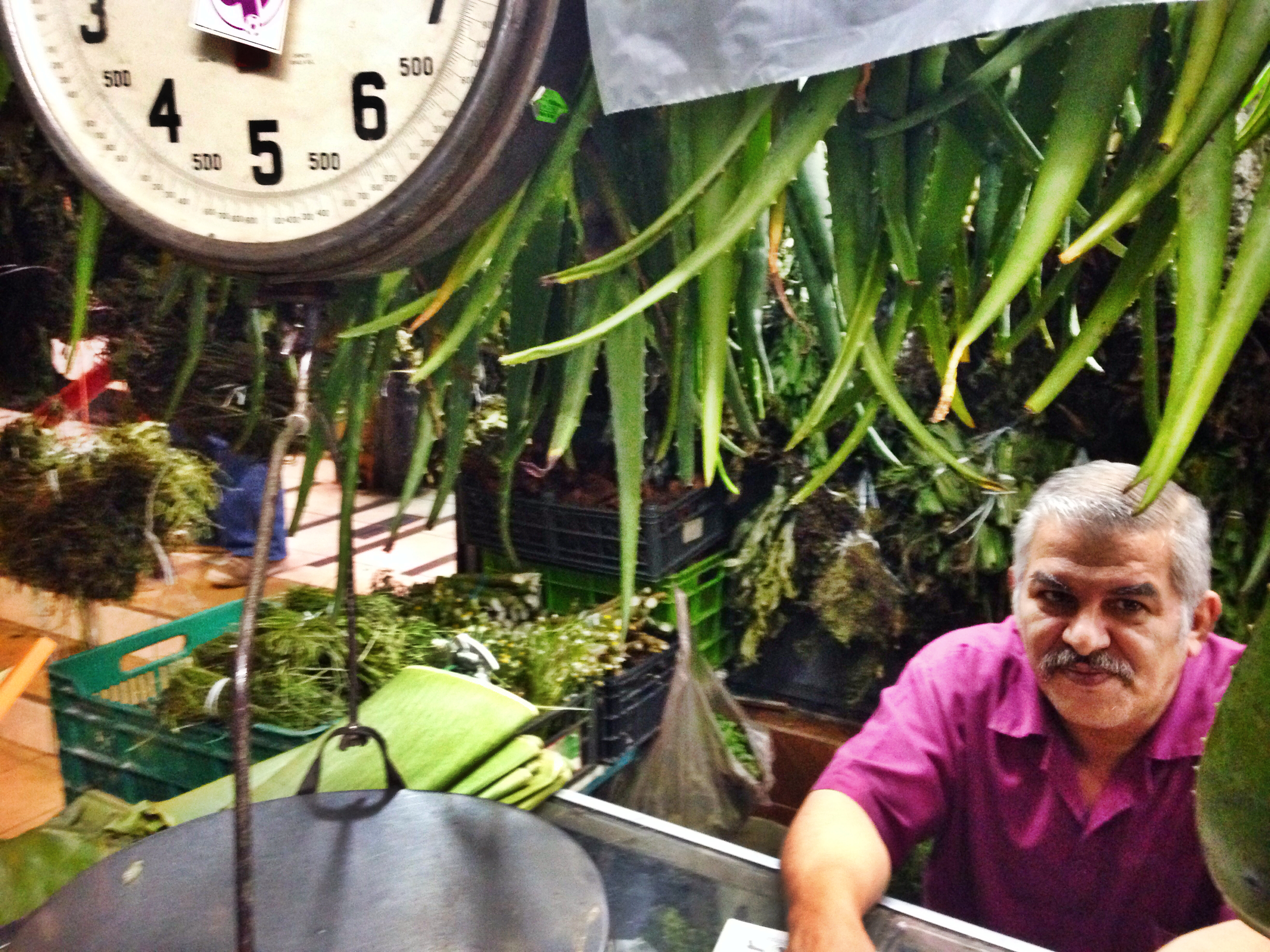
The Central Market of San José is a feast for the senses, filled with fresh fruits, veggies, flowers, medicinal plants, clothes, souvenirs, seafood, pets, handicrafts, you name it! Before devling into these bustling aisles during a recent class excursion, Prof Mireya gave a spiel about the capital’s commerical heart:
“The Mercado Central is located between Avenidas 0 and 1 and Calles 6 and 8. It was established in 1880 and declared national patrimony in 1995. Part of the building dates to the end of the 1800s and part was built in the 1940s. The market’s narrow aisles are always full of life, with their own manifestations of popular culture, from typical food and handicrafts, to herbs and ways of speaking.”
“Està ubicado entre las avenidas 0 y 1 y las calles 6 y 8. Fue establecido en 1880 y declarado patrimonio nacional en 1995. Una parte de su edificio data, precisamente, de finales del siglo XIX y otra fue construida en los años 40 del siglo pasado. Sus angostos pasillos siempre están llenos de vida, con manifestaciones propias de la cultura popular costarricense como la gastronomía, la artesanìa, la herbolaria, y también las formas de hablar.”
Just a few of the souvenirs at the Mercado Central in San Jose, Costa Rica.
The hand-painted sign showing two bridled horses does not point towards a fancy place. Turning down this stone driveway off the main road through Las Nubes will not deliver you to a state-of-the-art equine training facility. Nor are these lush pastures described in any Lonely Planet guidebooks. Yet, the animals grazing these hills speak volumes about the culture of Costa Rica’s Central Valley, where horses are not just historical throwbacks but remain essential for work, getting around and showing off in distinctly Tico style.
About 5 km from the school “Coronado a Caballo” offers informal, very affordable “cabalgatas” ( trail rides), based out of a modest stable with 50 or so well-cared-for horses, frequented by Ticos much more than foreign tourists. The Costa Rican saddle horses raised here are colloquially known as “criollos,” descended from Spanish and Peruvian breeds. Some are trained to make impressive, dance-like movements, with dramatic knees and dropped noses, like someone who sees a spider in every step. The trail horses are less flashy, with smooth sure-footed gaits even in rough terrain.
The hills and farms east of our Coronado campus certainly qualify. While only a short distance from the most densely populated and urbanized cities in the country, much of the highlands are still only accessibly by horse, motorbike or 4×4 vehicle. The road to Las Nubes disintegrates into skeins of rock and mud about 10 km from the school as it passes near the edge of Braulio Carrillo National Park.
Horseback riding provides unique panoramic views of the Central Valley below, the Cordillera Central mountains and cloud forests above. Plus that sense of freedom and possibility that for whatever reason, only seems to come when you’re a meter off the ground on the back of a trusty horse.
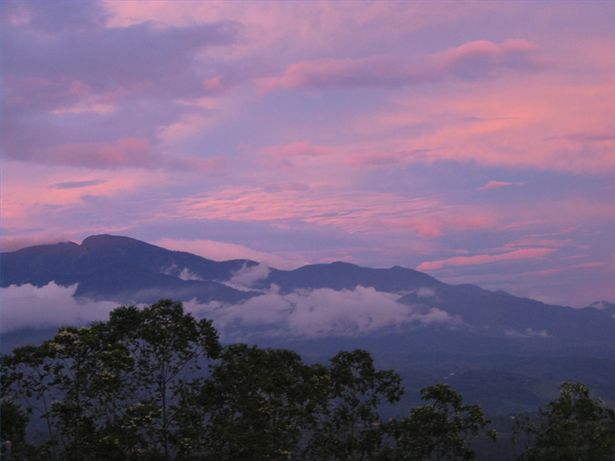
The light and the land in Coronado, San Jose, Costa Rica.
A few of Academia Tica’s most experienced instructors offered advice on how to begin the rewarding process of learning Spanish. With 65 years of teaching experience between them, we thought it worthwhile to share these kernels of wisdom with the world. Enjoy!
“The number one must for new students is simply wanting to study. Step two is actually studying, then studying, studying and studying some more. Finally, don’t just practice in the classroom, practice anytime you can with whomever you can, at the supermarket, with friends, colleagues or your host family.” -Elizabeth Gamboa
“If you want to learn you have to have an open mind, be willing to be surprised and not rationalize everything according to what you are already know. Really open your mind and admire what you are learning. Feel the language, feel the rhythm and let it flow.” – Santiago González
“It is very important to practice after class. You don’t even need another person to do this. Use a mirror and talk to yourself if you need to. Practice the structure and the grammar. It is not enough to only practice in class because you will forget things.” – Mireya Mora
The experts agree: hard work, openness and a good attitude are at the heart of learning anything new. But immersion might be the closest thing to a magic bullet for learning a language, along with committed teachers who actually care about your progress.
Events this month include traditional festivals, great movies, interesting fairs, diverse music and dance performances from all over the world.
Movies
Cine Magaly: This month a series celebrating female perspectives, “Cine con Lentes de Mujer,” will screen every Saturday at 1 pm in the Club Magaly, including “Caramelo” and “El Piano”.
University Cinema: After the semester is over the series of free movies at the University continues with the “Month of Architecture and Cities.” Every Thursday and Friday after Aug. 14, 6:30 pm at the Auditorium of Law (San Pedro).
Fairs
Let the exhibitors at the travel & tourism fair help you plan your next Costa Rica excurision, Aug. 21, from 11 am – 5 pm at the Hotel Sleep Inn .
Looking for a new book to practice your Spanish? The International Book Fair opens from Aug. 22-31, 9 am – 8 pm, at the Antigua Aduana in San José.
The fair “Diseño Gourmet” may be a good chance to buy some unique souvenirs and see how design and gourmet make a great match, Aug. 2, 8 am – 4 pm at the Shopping Center La Paco in Escazú.
The boys chorus from Vienna (“Wiener Saengerknaben”) will give concerts in Escazú (August 22nd) and in the National Theater in San José (August 24th). Photo by Simkultur
Music and Dance
The opera “Nabucco” by Guiseppe Verdi, epic retelling of the biblical story of King Nebuchadnezzar will be played in the National Theater on Thursdays and Fridays at 7:30 pm and Sundays at 5 pm until August 10th.
The National Festival of Contemporary Dance features one to three renowned acts daily August 5 – 10, 8pm at alternately at the Teatro Melico Salazar or the Teatro de la Danza.
The “Wiener Saengerknaben”, a boys chorus from Vienna, will hold a free concert on Aug. 22 at 7:30 pm, Plaza Tempo (next to Holiday Inn) in Escazú. Hear them at the National Theater on Aug. 24 at 5 pm. Part of the “Festival de Música Credomatic.”
The Afro-cultural Festival continues with different music and dance performances, starting with the Limón Roots Awards Aug. 20 at 7 pm in the National Theater in San José. The grand final of the 10-day festival is the Gala Parade, Aug. 31 in Limón.
The annual Gospel Festival “Let it Shine” features various choruses and artists, Aug. 30 at 7:30 pm at the Teatro Popular Melico Salazar.
Traditional & religious celebration
Experience authentic Costa Rican culture during a popular celebration in San Ramón de Alajuela, including a procession with about 60 images of saints brought to the center of town, traditional festivities with live music and typical food, from Aug. 30 – 31.
Feature image of the National Festival of Contemporary Dance by La Nacion.
When we pull up to his Escazú home, Gerardo Montoya hits play.
Parade sounds fill this sleepy neighborhood in the hills overlooking Costa Rica’s capital city. Crashing cymbals and snare drums punch off time as we walk down the driveway towards a garage workshop where our host awaits, dancing among the monsters he’s created, many of them large enough to swallow a man whole.
He cuts the music and announces:
“Meet my second family!”
There is el Chupacabra the blood sucking goat killer, just chilling next to Martina the spunky abuela. There are grinning diablos crowding long-nosed brujas, witches in cahoots with their equally hideous boyfriends, the brujos. There’s the hot pink-cheeked Rosita, a fat Spanish madam who spends most of her time with the hairless, tirelessly ambitious el Calvo. There’s la Segua, half beautiful woman, half dead horse. Her hobbies include hanging around water and scaring the pants back on unfaithful husbands. There’s Pancho the humble rancher, El Chino the racial stereotype and in the back there is Gerardo, a mask modeled after its maker, the likeness uncanny.
The “real” Gerardo Montoya beams as he explains the family history. His grandfather was Pedro Arias, one of the most famous mid-century Costa Rican mask-makers or mascareros, who defined an aesthetic style still used all over the country to make these paper mâché “payasos,” beloved guests at every popular festival or celebration, prone to spontaneous dancing and the chasing of children.
Montoya founded this workshop about 20 years ago, after hard times drove the family to sell its farmland in Escazú. Property values promptly sky-rocketed. Montoya has said within three years the German investor who bought that two hectare property was offered more than triple the amount he paid. This kind of story is typical of the rapid transformation taking place in this increasingly affluent cantón, 8 kilometers from central San José.
To get to the mask workshop, we first pass “new” Escazú’s towering condominiums, its gleaming skyscrapers and a colossal shopping mall. We don’t stop at Hooter’s, nor at the liquor store with an LED sign called La Bruja. We ascend narrow residential streets lined with locked gates, shiny cars and for sale signs featuring swimming pools. Near the end we pass an historic Catholic Church, a mural dedicated to cattle ranching and a 100-year-old adobe house where legend has it a real witch once lived. Finally, we climb the steepest grade yet, toward the cloud forests of Pico Blanca. Half-way up we arrive at Montoya’s home and workshop, 200 meters past the water treatment plant where he now works as a technician.
That’s his day job, but “…This is happiness for me,” he says, motioning to the masks.
“To sell a mask would be like selling a son.”
Though, he does have seven of them. (Sons, that is.) Two have learned to make the traditional masks, using clay to create molds that are then covered in strips of newspaper soaked in yucca gum, left to dry, mounted on wooden or metal frames and painted. It´s a month-long process before they are ready. Montoya doesn’t sell the masks, instead renting them to municipalities for popular festivals, which abound in Costa Rica. Famous for exemplifying the Central Valley style, Montoya’s masks were even used during the 1998 presidential inauguration of Miguel Angel Rodríguez.
At our tour Pedro Montoya, one of the seven sons, disappears under the skirt of a giganta, her gaudily made-up face and blonde hair a parody of a colonial Spanish dueña. He begins to dance like there’s nothing at all precarious about this situation, flirting shamelessly with our driver and facilities manager, Ricardo.
Next we assume some strange forms ourselves.
Upon reflection, wearing that mask and dancing like a maniac in Montoya’s driveway reminds me of learning Spanish through immersion. The giddiness and the sweat. The sense that whatever I want to convey is distorted by what I can convey. Feeling foolish and realizing that is actually kind of fun. The exaggerated gestures and lack of subtlety. The smiles and the laughter. The art of not taking oneself too seriously.
-Emily Jo Cureton
Academia Tica students masquerade at Montoya’s Escazú studio, home to traditional Costa Rican masks used for festivals around the country.