Tag: History

  • Changing face in Escazú

    Changing face in Escazú

    When we pull up to his Escazú home, Gerardo Montoya hits play.

    Parade sounds fill this sleepy neighborhood in the hills overlooking Costa Rica’s capital city. Crashing cymbals and snare drums punch off time as we walk down the driveway towards a garage workshop where our host awaits, dancing among the monsters he’s created, many of them large enough to swallow a man whole.

    He cuts the music and announces:

    “Meet my second family!”

    There is el Chupacabra the blood sucking goat killer, just chilling next to Martina the spunky abuela. There are grinning diablos crowding long-nosed brujas, witches in cahoots with their equally hideous boyfriends, the brujos. There’s the hot pink-cheeked Rosita, a fat Spanish madam who spends most of her time with the hairless, tirelessly ambitious el Calvo. There’s la Segua, half beautiful woman, half dead horse. Her hobbies include hanging around water and scaring the pants back on unfaithful husbands. There’s Pancho the humble rancher, El Chino the racial stereotype and in the back there is Gerardo, a mask modeled after its maker, the likeness uncanny.

    The “real” Gerardo Montoya beams as he explains the family history. His grandfather was Pedro Arias, one of the most famous mid-century Costa Rican mask-makers or mascareros, who defined an aesthetic style still used all over the country to make these paper mâché  “payasos,” beloved guests at every popular festival or celebration, prone to spontaneous dancing and the chasing of children.

    Montoya founded this workshop about 20 years ago, after hard times drove the family to sell its farmland in Escazú. Property values promptly sky-rocketed. Montoya has said within three years the German investor who bought that two hectare property was offered more than triple the amount he paid. This kind of story is typical of the rapid transformation taking place in this increasingly affluent cantón, 8 kilometers from central San José.

    To get to the mask workshop, we first pass “new” Escazú’s towering condominiums, its gleaming skyscrapers and a colossal shopping mall. We don’t stop at Hooter’s, nor at the liquor store with an LED sign called La Bruja. We ascend narrow residential streets lined with locked gates, shiny cars and for sale signs featuring swimming pools. Near the end we pass an historic Catholic Church, a mural dedicated to cattle ranching and a 100-year-old adobe house where legend has it a real witch once lived. Finally, we climb the steepest grade yet, toward the cloud forests of Pico Blanca. Half-way up we arrive at Montoya’s home and workshop, 200 meters past the water treatment plant where he now works as a technician.

    That’s his day job, but “…This is happiness for me,” he says, motioning to the masks.

    “To sell a mask would be like selling a son.”

    Though, he does have seven of them. (Sons, that is.) Two have learned to make the traditional masks, using clay to create molds that are then covered in strips of newspaper soaked in yucca gum, left to dry, mounted on wooden or metal frames and painted. It´s a month-long process before they are ready. Montoya doesn’t sell the masks, instead renting them to municipalities for popular festivals, which abound in Costa Rica. Famous for exemplifying the Central Valley style, Montoya’s masks were even used during the 1998 presidential inauguration of Miguel Angel Rodríguez.

    At our tour Pedro Montoya, one of the seven sons, disappears under the skirt of a giganta, her gaudily made-up face and blonde hair a parody of a colonial Spanish dueña. He begins to dance like there’s nothing at all precarious about this situation, flirting shamelessly with our driver and facilities manager, Ricardo.

    Next we assume some strange forms ourselves.

    Upon reflection, wearing that mask and dancing like a maniac in Montoya’s driveway reminds me of learning Spanish through immersion. The giddiness and the sweat. The sense that whatever I want to convey is distorted by what I can convey. Feeling foolish and realizing that is actually kind of fun. The exaggerated gestures and lack of subtlety. The smiles and the laughter. The art of not taking oneself too seriously.

    -Emily Jo Cureton

    Academia Tica students masquerade at Montoya's Escazú studio, home to traditional Costa Rican masks  used for festivals around the country.
    Academia Tica students masquerade at Montoya’s Escazú studio, home to traditional Costa Rican masks used for festivals around the country.


  • Costa Rica’s stone balls join World Heritage

    Costa Rica’s stone balls join World Heritage

    Costa Rica’s iconic stone spheres have been recognized for their value to World Heritage by the United Nations Educational, Scientific and Cultural Organization (UNESCO), bringing more international attention to the southern region’s mysterious past, as well as its contentious future.

    No one knows who made a single one of the preColombian stone spheres, let alone why more than 300 were sculpted to near geometric perfection more than 1,000 years ago. Like Stonehedge and Easter Island, the petrospheres have piqued archaeological inquiry and fantastical supposition since the first examples were unearthed by banana plantation workers in the mid-19th century.

    Ranging in size from a child’s fist to a wrecking ball, some arrangements suggest that the spheres aligned with the stars or served as monumental compasses. Local lore has it that they were the playthings of a god hell-bent on controlling the weather, still other theories contend they make perfect instruments for ancient alien air traffic control. The truth is, no one really knows what the original sculptors had in mind or even exactly when they lived.

    The endurance of mystery may be just another reason for Las Bolas to join UNESCO’s elite list of sites thought to exemplify human heritage, so often defined by desperately wanting to know, rather than actually knowing. Officially, the qualifying criteria for the sphere sites is that they “bear a unique or at least exceptional testimony to a cultural tradition or to a civilization which is living or has disappeared.”

    (With La Sele’s historic upset advance to the finals of the World Cup, we can bear witness to the fact that ball-centrist culture has anything by disappeared.)

    The stone balls of yore were probably hand-carved by ancestors of the Boruca, Téribe and Guaymi peoples in Southern Costa Rica. Some believe ancients formed the rocks by dissolving them with a plant-based potion, though many scholars refute this. The exact timeline of production is also a point of debate. Unlike organic materials, rock cannot be carbon-dated. The approximate ages of the spheres are based on associated materials, usually sediments and pottery shards found at the installation site, which indicate that they could have been made during an 1,800 year period. (For some perspective: that’s considerably longer than the Spanish Monarchy has even existed).

    Some of the bolas are thought to weigh more than 15 tons. Others have been pocketed and used as mantle decorations. The UNESCO listing only applies to balls with a diameter of 70 cm or larger and its unclear how or if it will affect the many spheres that have been removed from Costa Rica. Of more than 300 recorded petrospheres found in the southern region about a dozen remain in their original context, according to an educated estimate by John W. Hoopes, an archaeologist whose research contributed to the UNESCO listing.

    “The main that this listing does is draw worldwide global attention to this site and others. The conservation of the site is ultimately the responsibility of the country in which its found,” Hoopes said via Skype. 

    Most if not all “in situ” spheres left are at the four locations recognized as international patrimony by UNESCO this week: Finca 6, Batamba, El Silencio and Grijalba 2. A new museum at Finca 6, a former banana plantation, gives the public a chance to see the spheres as they were installed centuries ago.

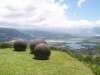
    An ancient stone sphere in a new context at Plaza Democracia in San José, Costa Rica. Of more than 300 known spheres, all but a dozen or so have been moved from their original locations in the southern zone.
    An ancient stone sphere in a new context at Plaza Democracia in San José, Costa Rica. Of more than 300 known spheres, all but a dozen or so have been moved from their original locations in the southern zone.

    The rampant damage and dispersion of the spheres began after United Fruit Company workers uncovered the first examples while clearing banana fields in 1940. Since then many have been rolled into gullies and ravines. Others were burned and cracked by fire when land was cleared for plantations. Still others were dynamited, or sent to faraway lands and used as prized lawn ornaments. Paris has one, so does Harvard. Some were stolen, others sold to the highest bidder.

    It seems the predominate human impulses upon encountering one of these testimonies to human heritage are to a) dig it up, b) roll it away or c) blow it up and hope gold falls out. (It doesn’t).

    The solid rock from which the spheres were sculpted came from the Talamanca Mountains and was probably naturally flooded to the lowlands down the Térraba River to the Diquís valley, where boulders would have been collected and transported upwards of 50 miles to some installation sites. Today the Diquís valley is the planned site for the largest hydro-electric project ever in Central America, a dam on the Superior General River between Buenos Aires, Osa, and Pérez Zeledón. In the works under another name for more than 30 years, construction began in 2009, but was stalled in 2011 by a lawsuit over indigenous rights and remains delayed by the construction of an associated pipeline. The El Diquís project would flood 6815 ha  (27 sq mi) to create 631 megawatts of power for 1 million consumers, many of them in Panama, according to the Institute for Costan Rican Electricity ICE. It would inundate protected indigenous territories, displacing at least 1,500 people and “irremediably affecting” 150 archaeological sites, according to an impact summary by the University of Costa Rica.

    For more context about the World Heritage site designation, check out this article en español.

    President Solis poses with a stone sphere in San José after four archaeological sites in Southern Costa Rica were added to UNESCO's World Heritage List.
    President Solis poses with a stone sphere in San José after four archaeological sites in Southern Costa Rica were added to UNESCO’s World Heritage List.

    -Emily Jo Cureton

  • Into the volcano! (one of them anyway)

    Into the volcano! (one of them anyway)

    The distinction between earth and sky seems more an ongoing negotiation than a fact from atop Irazú, the tallest active volcanic peak in Costa Rica and an easy half-day trip from Academia Tica’s Coronado campus.

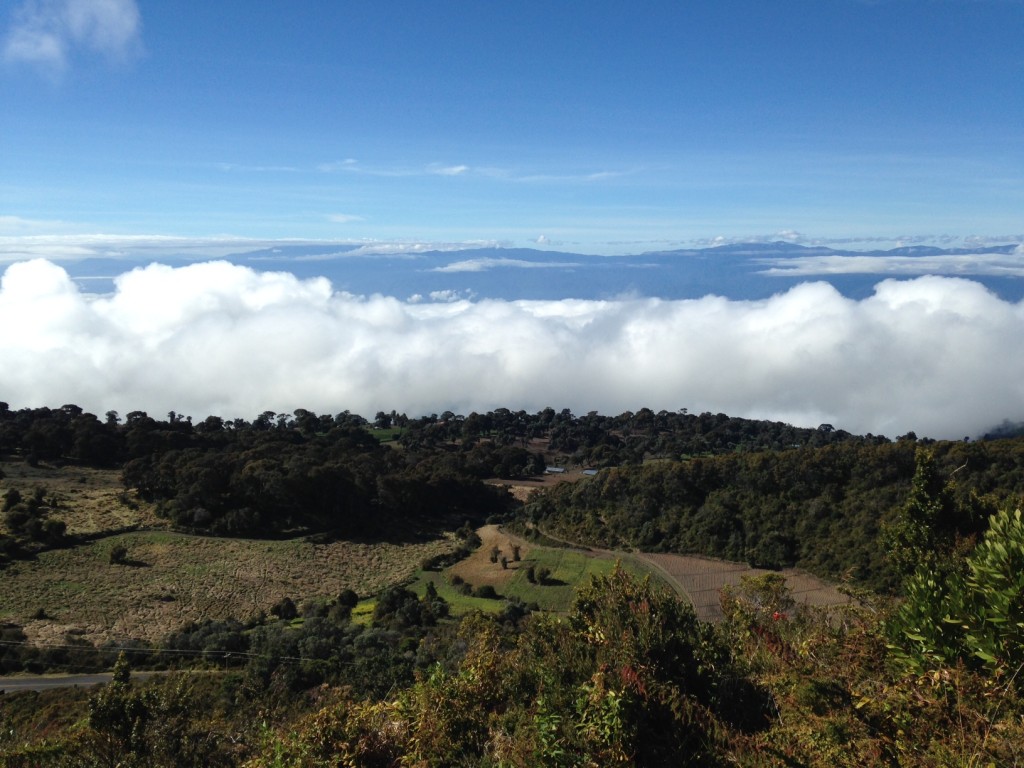
    There are more clouds below us than above on this dry May morning. They unfurl at our feet like plush white carpets reaching all the way to the Caribbean Gulf on one side and the Pacific on the other.

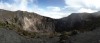
    The view from a ridge line above the principal crater at Parque Nacional Volcan Irazu, the highest volcanic peak in Costa Rica, an easy and incredibly scenic day trip from Academia Tica Coronado.

    On a clearer day we could see two oceans at once, a staggering perspective unique to this place in Central America. But even in the company of clouds and intermittent fog we can take in all of Central Costa Rica, a dense mosaic of rain forests, farm, rivers and mountains, home to over 500,000 thousand species of life and counting.Looking away from the limitless horizon to the black sand underfoot. Eyes plummet 300-meters down to the bottom of Irazu’s principal crater, a monumental hole in the ground painted lifeless grays and blacks by the same process that created the brilliant greens surrounding us, highly productive and populated agricultural regions.

    Irazú formed in the Pleistocene era, (between 2 million and 12,000 years ago). In the past 100 years the volcano has experienced seven eruption cycles, the latest occurring from 1963-65, when debris choked rivers and flooded the city of Cartago. San Jose (and nearby Academia Tica) are a much safer distance away, though one account recorded 20 inches of ash falling on parts of the city during the 1963-65 eruptions. While often pictured with an ephemeral lake, Costa Rica is in the middle of a dry spell (by tropical standards), and the bottom of the crater is dry and visible this year. This ever shifting topography masks two roiling magma chambers another 3000 meters below the surface.

    Tempted to try out ground as nebulous and inviting as the sky, but signs warn us that gravity slides can result from the slightest disturbance of the barren slopes. The national park here provides drive-up access and paved paths to the principal crater, utilizing a relatively stable terrace on the south side called Playa Hermosa, where hardy plants and animals stake claim on the volcanoes first habitable areas.

    Scraggly tufts of grass dotting Playa Hermosa eventually thicken enough to host picnicking Tico families, low shrubs make a tenuous comeback, and then the first fierce little Myrtle trees post up. Sparseness ends abruptly at a tree line so dense we can only hear the human visitors laughing, scrambling and clamoring within it. Climbing into this forest on the edge of desolation, we startle hummingbirds and lizards galore, ascending to a ridge above the principal crater where we are rewarded with even more epic views of this strange and wonderful place.

    Uniquely accessible for an active volcano, Parque Nacional Volcan Irazu is an easy day trip for students at Academia Tica, who can go with an organized tour group or independently via bus, rental car or taxi. Irazu is but one of many volcanoes that forge the highland backbone of Costa Rica.