Tag: Costa Rica

  • Changing face in Escazú

    Changing face in Escazú

    When we pull up to his Escazú home, Gerardo Montoya hits play.

    Parade sounds fill this sleepy neighborhood in the hills overlooking Costa Rica’s capital city. Crashing cymbals and snare drums punch off time as we walk down the driveway towards a garage workshop where our host awaits, dancing among the monsters he’s created, many of them large enough to swallow a man whole.

    He cuts the music and announces:

    “Meet my second family!”

    There is el Chupacabra the blood sucking goat killer, just chilling next to Martina the spunky abuela. There are grinning diablos crowding long-nosed brujas, witches in cahoots with their equally hideous boyfriends, the brujos. There’s the hot pink-cheeked Rosita, a fat Spanish madam who spends most of her time with the hairless, tirelessly ambitious el Calvo. There’s la Segua, half beautiful woman, half dead horse. Her hobbies include hanging around water and scaring the pants back on unfaithful husbands. There’s Pancho the humble rancher, El Chino the racial stereotype and in the back there is Gerardo, a mask modeled after its maker, the likeness uncanny.

    The “real” Gerardo Montoya beams as he explains the family history. His grandfather was Pedro Arias, one of the most famous mid-century Costa Rican mask-makers or mascareros, who defined an aesthetic style still used all over the country to make these paper mâché  “payasos,” beloved guests at every popular festival or celebration, prone to spontaneous dancing and the chasing of children.

    Montoya founded this workshop about 20 years ago, after hard times drove the family to sell its farmland in Escazú. Property values promptly sky-rocketed. Montoya has said within three years the German investor who bought that two hectare property was offered more than triple the amount he paid. This kind of story is typical of the rapid transformation taking place in this increasingly affluent cantón, 8 kilometers from central San José.

    To get to the mask workshop, we first pass “new” Escazú’s towering condominiums, its gleaming skyscrapers and a colossal shopping mall. We don’t stop at Hooter’s, nor at the liquor store with an LED sign called La Bruja. We ascend narrow residential streets lined with locked gates, shiny cars and for sale signs featuring swimming pools. Near the end we pass an historic Catholic Church, a mural dedicated to cattle ranching and a 100-year-old adobe house where legend has it a real witch once lived. Finally, we climb the steepest grade yet, toward the cloud forests of Pico Blanca. Half-way up we arrive at Montoya’s home and workshop, 200 meters past the water treatment plant where he now works as a technician.

    That’s his day job, but “…This is happiness for me,” he says, motioning to the masks.

    “To sell a mask would be like selling a son.”

    Though, he does have seven of them. (Sons, that is.) Two have learned to make the traditional masks, using clay to create molds that are then covered in strips of newspaper soaked in yucca gum, left to dry, mounted on wooden or metal frames and painted. It´s a month-long process before they are ready. Montoya doesn’t sell the masks, instead renting them to municipalities for popular festivals, which abound in Costa Rica. Famous for exemplifying the Central Valley style, Montoya’s masks were even used during the 1998 presidential inauguration of Miguel Angel Rodríguez.

    At our tour Pedro Montoya, one of the seven sons, disappears under the skirt of a giganta, her gaudily made-up face and blonde hair a parody of a colonial Spanish dueña. He begins to dance like there’s nothing at all precarious about this situation, flirting shamelessly with our driver and facilities manager, Ricardo.

    Next we assume some strange forms ourselves.

    Upon reflection, wearing that mask and dancing like a maniac in Montoya’s driveway reminds me of learning Spanish through immersion. The giddiness and the sweat. The sense that whatever I want to convey is distorted by what I can convey. Feeling foolish and realizing that is actually kind of fun. The exaggerated gestures and lack of subtlety. The smiles and the laughter. The art of not taking oneself too seriously.

    -Emily Jo Cureton

    Academia Tica students masquerade at Montoya's Escazú studio, home to traditional Costa Rican masks  used for festivals around the country.
    Academia Tica students masquerade at Montoya’s Escazú studio, home to traditional Costa Rican masks used for festivals around the country.


  • What’s on in July?

    What’s on in July?

    This is going to be a fun month!

    Events coming up include the University cinema’s “Month of Laughter,” music festivals, a national surf championship, traditional Costa Rican and American celebrations and a “Night at the museum(s)”.

    4th of July Picnic
    For all the Americans who are going to be in Costa Rica for the Independence Day, the American Colony Committee organizes this annual picnic at the Cervecería Nacional near the International Airport from 9 am to 1 pm. Enjoy a piece of homeland culture with food, music, shows, sports and a flag raising ceremony. Fireworks at the Avenida Escazú at 7 pm make this day complete.

    Under Rock Festival
    This music event is lead by five different bands and a DJ rocking the stage at Mundoloco el Chante in San Pedro on the 4th of July at 7 pm.

    International Calypso Festival
    For the second time the Calypso Festival happens in the Caribbean town Cahuita this weekend, July 4th-6th, including national and international music acts, sports, games, and more: the festival has something to offer everyone.

    Fashion Week
    Visit the most important fashion event of Costa Rica this month. From July 10th to 13th national and international designers present the new trends with live runways, shows and workshops at the Antigua Aduana in San José.

    Art City Tour
    This event gives you the chance to see many of the museums and galleries in San José for free from 5 pm to 9 pm on July 16th. The provided shuttle take you from one spot to another.

    Precolumbian Art
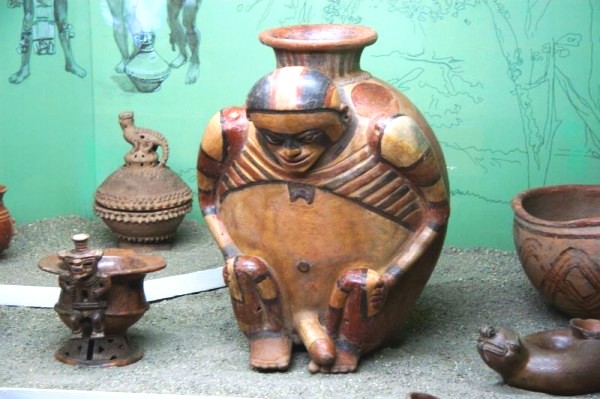
    Pieces of pre-Columbian art you can see at the museums in San José during the Art City Tour (Photo by redcultura.com)

    Two traditional Costa Rican events
    The week-long festival of the Virgin of the Sea (July 13th to 20th) in honor of the patron saint Carmen comes along with horse parades or colorful regattas in Puntarenas and in Playas del Coco. Another event is the Day of Guanacaste (July 25th) celebrating the annexation of Nicoya from Nicaragua with rodeos, parades, typical food and music acts in different cities.

    Gran Final Reef 2014
    On the long weekend, July 25th-27th, the best surfers of Costa Rica flock to Playa Hermosa (near Jacó) to show their skills and try to return home with the title “National Champion”. The competitions will take place from 7 am to 4 pm daily and are accompanied by shows of “Las Chicas Reef”, concerts and parties in the surrounding beach bars, an air show and last but not least the big award ceremony.

    University Cinema
    July’s theme of the free movies on the campus is “Month of Laughter”. Comedies like Some like it hot, La loca historia del mundo, Shhh! Top secret! and many more are shown on Thursdays and Fridays starting with a discussion at 5:30 pm and the actual screening at 6:30 pm at the Auditorium of Law (Avenida 13, San Pedro).

    Also check out the regular events going on around the capital.

  • Amazing corn

    Amazing corn

    We loaded our plates with fresh empañadas, cheesy tortillas and sweet chorreadas, unwrapping huge banana leaves to reveal steaming tamales filled with  veggies and meat. We ohhed, ahhed and salivated over the tamal asado, a sticky sweet cornbread that frankly put me over the edge of satisfied, too full to try any more typical Costa Rican dishes made from maize, the star ingredient in this Tuesday tasting class.

    When we look at any Costa Rican table today, chances are at least one thing on it was born of corn, that versatile staple vital to life all over the Americas since time immemorial. If we were to dig in the gooey sediment of Guanacaste lakes, we would uncover 5,000 year old maize pollens. If we dove to the bottom of Arenal Lagoon, we might resurface with charred cobs from 2000 BC. But even as technology like carbon-dating and genetic sequencing shuck the history of modern maize, its origins remain mysterious and its future uncertain.

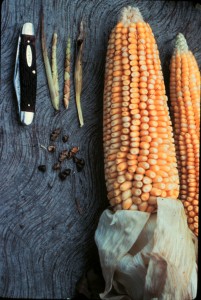
    Modern corn with its diminutive ancestor, teosinte.
    Modern corn with its diminutive ancestor, teosinte.

    Most scholars agree maize was domesticated between 7,500 and 12,000 years ago in Mexico. Its nearest wild relative is a grass species called teosinte, in which each teeny tiny kernel is enclosed in a hard shell. It remains unclear how prehistoric Americans managed to cultivate the starchy stuff of tamales from this unpromising ancestor, itself barely a mouthful, hardly worth the effort for even the most industrious omnivore.

    Mankind’s unlikely mastery of maize has far from run its course. In 2013, some 32 percent of corn grown in the entire world was genetically modified in some way, meaning it contained genes that were altered by humans with the intention of making the crop more productive, resistent to drought, bugs and blights, or some combination of these. About 90 percent of corn grown in the United States that year came from GM seeds, which are typically patented by the multinational corporations that developed them.

    Because of patents, farmers can not legally use GM seeds without buying new ones every single season. For example, Monsanto, one of the world’s biggest and most profitable GMO producers, pursued 145 lawsuits relating to patent control between 1997 and 2012.

    We need not root around very long to get an earful about GMOs. Many say patent laws foster monopolies that put small farmers out of business while monocultures (single crop plantations) are underming soil longevity and overall ecosystem health as they wreak unintended havoc on human health, too. Others say that GMOs are a necessary innovation in agriculture, one that allows us to use less while producing more, developed in response to ballooning populations and dwindling water supplies.

    The debate over GM corn is a fiery one in a country where extensive agriculture and extremely high biological diversity coexist. Currently, Costa Rica does not produce GM corn, (however, GM cotton, soybeans, pineapple and banana plots are grown here). This exclusion could change soon. In Jan. 2013 a subsidiary of Monsanto gained approval from Costa Rica’s National Biosecurity Technical Commission to grow corn, sparking mass protests and a legal appeal, which put the project on hold until Costa Rica’s Supreme Court reviews its constitutionality. By 2013, 66 out of 82 cantons in Costa Rica had passed laws prohibiting GMOs in some way. Still, no national law backs this popular majority and GMO projects are ultimately approved or denied by the feds on a case by case basis.

    The introduction of GM corn is especially high stakes because unlike soybeans and cotton, corn pollinates on the whims of the wind. Many believe GM seeds will contaminate native fields and make it very difficult for farmers to grow heritage crops.

    But when I bit into the chorreadas at Tuesday’s class, I tasted neither the history of civilization nor its fate, just the indescribable sweetness of American corn, smothered in sour cream.

    Updated 7/8/14: Supreme Court readies to decide GM Corn Challenge

    -Emily Jo Cureton

  • Events: Football and more

    Events: Football and more

    Cool upcoming events include an international food fair in Coronado, more than 100 activities in the capital and of course the World Cup.

    Food: “Feria Internacional De Comida Típica”
    Sick of “Gallo Pinto,” yet?  Or maybe ready for another serving? The International Fair of Typical Food offers Costa Rican favorites, and also Caribbean and Latin American specialties from 10am to 6pm this Saturday, June 21st at the Inter-American Institute for Cooperation on Agriculture in Coronado.

    Culture: “100 en un día”
    This event on Saturday, June 21st in San José consists of many activities voluntarily organized by citizens who want to turn their home into a nicer and livelier place one small step at time… times 100! Learn indigenous handicraft techniques in creative workshops, see water of all colors coming out of the cities fountains, get free hugs, listen to the stories of homeless people, watch folkloric dance, get to know San José during a mini city tours, be a part of a flash mob or have a picnic with random people… Check the event map and schedule on the website or just go and stroll around in the central streets and parks to see what’s going on.

    Exhibition: Soccer stadiums of the world
    In honor of World Cup madness, an exhibition called “Las catedrales del fútbol” shows where the magic happens from a different point of view. Architecture and impressive capacity come to life with flag-waving fans, the joys and frustrations of thousands piqued by a tiny ball… All captured in these photos.
    Visit the exhibition until August 1st in the Centro Cultural de España in San José (Calle 31, Avenida 13).

    World Cup: Where to watch the games
    Last week we celebrated the win of the Costa Rican team in the sports club Los Jaúles.  Today at school we had an awesome time cheering for our team in the game vs. Italy!! If you are looking for another place to see  matches, here are some tips from the staff in Coronado: Just in short walking distance down the street from the school you´ll find the bar “Los Socios”, for the weekends the karaoke bar “Las Cantares” above the supermarket “AM PM” and last but not least we recommend the bar and restaurant “Las Villas San Isidro” (from the church pass the park on the main street, turn left at the gas station and again left on the second street). If you look for something bigger: In San José is a large screen broadcasting all the games on the Plaza de la Democracia, right in front of the National Museum.

  • ¡Oé, oé, oé!

    ¡Oé, oé, oé!

    When Costa Rican player Marco Ureña sent a third point into Uruguay’s goal during Saturday’s World Cup game, a nation of spectators already thought to be the happiest people on earth became the most elated people on earth. No one expected the Costa Rican team to hold its own against Uruguay, let alone trounce the 2010 semifinalist team in a 3-1 upset. We watched the exciting second half of the match among the crowd at Club Los Jaules, (a sports club in Coronado where AT students enjoy complimentary membership). We snagged this video of the club’s lounge erupting with joy right after Costa Rica scored the final goal.

    ¡Oé!