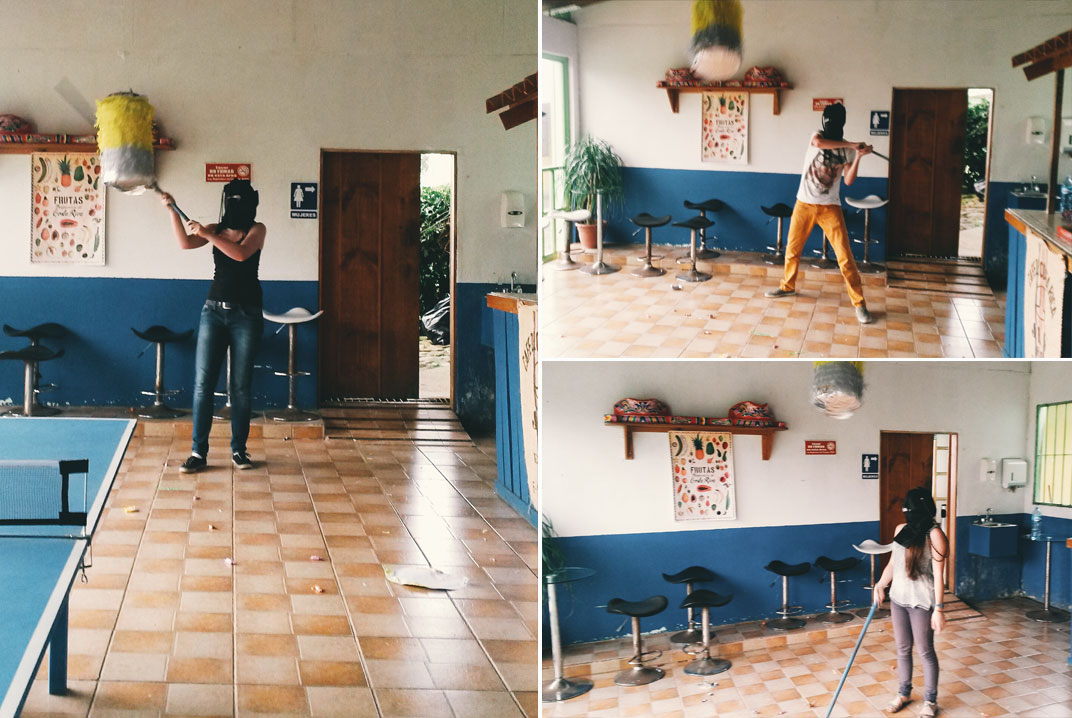
Nuestro querido estudiante Eli es el nuevo campeón de ping pong de la academia. El mismo día de su cumpleaños ganó el torneo y recibió una piñata por parte de sus compañeros, que después reventó con mucho esfuerzo.
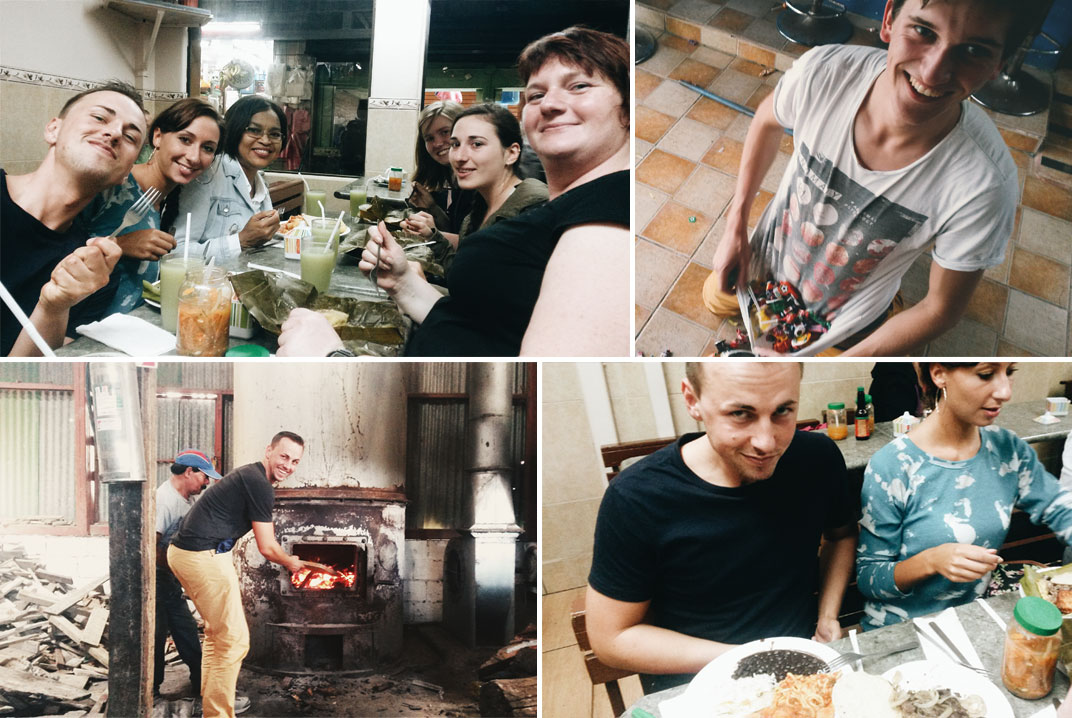
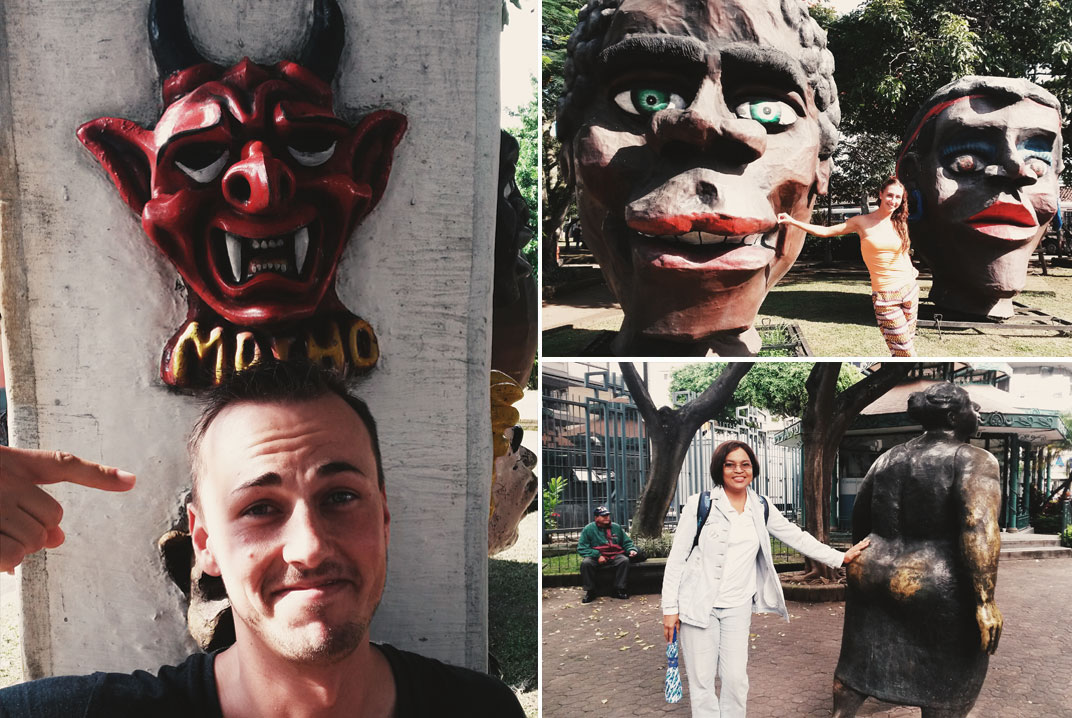
Esta misma semana visitamos el centro de San José y el Mercado Central. Comimos en una auténtica “soda” tipica y descubrimos que a todos nos gusta el cas.
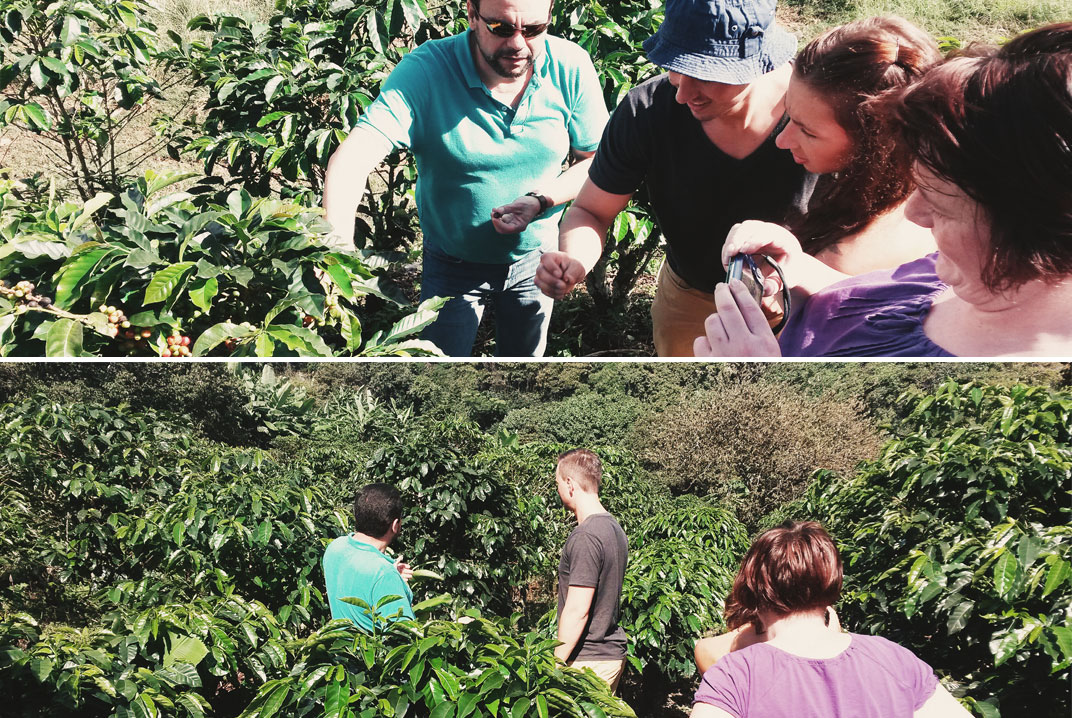
La última actividad a la que asistimos la semana pasada fue la visita a un beneficio y plantación de café. Aprendimos sobre el proceso del café y luego visitamos el parque de Barva en la provincia de Heredia. La pasamos muy bien en todas las actividades, ¡aquí están las fotos que lo demuestran!
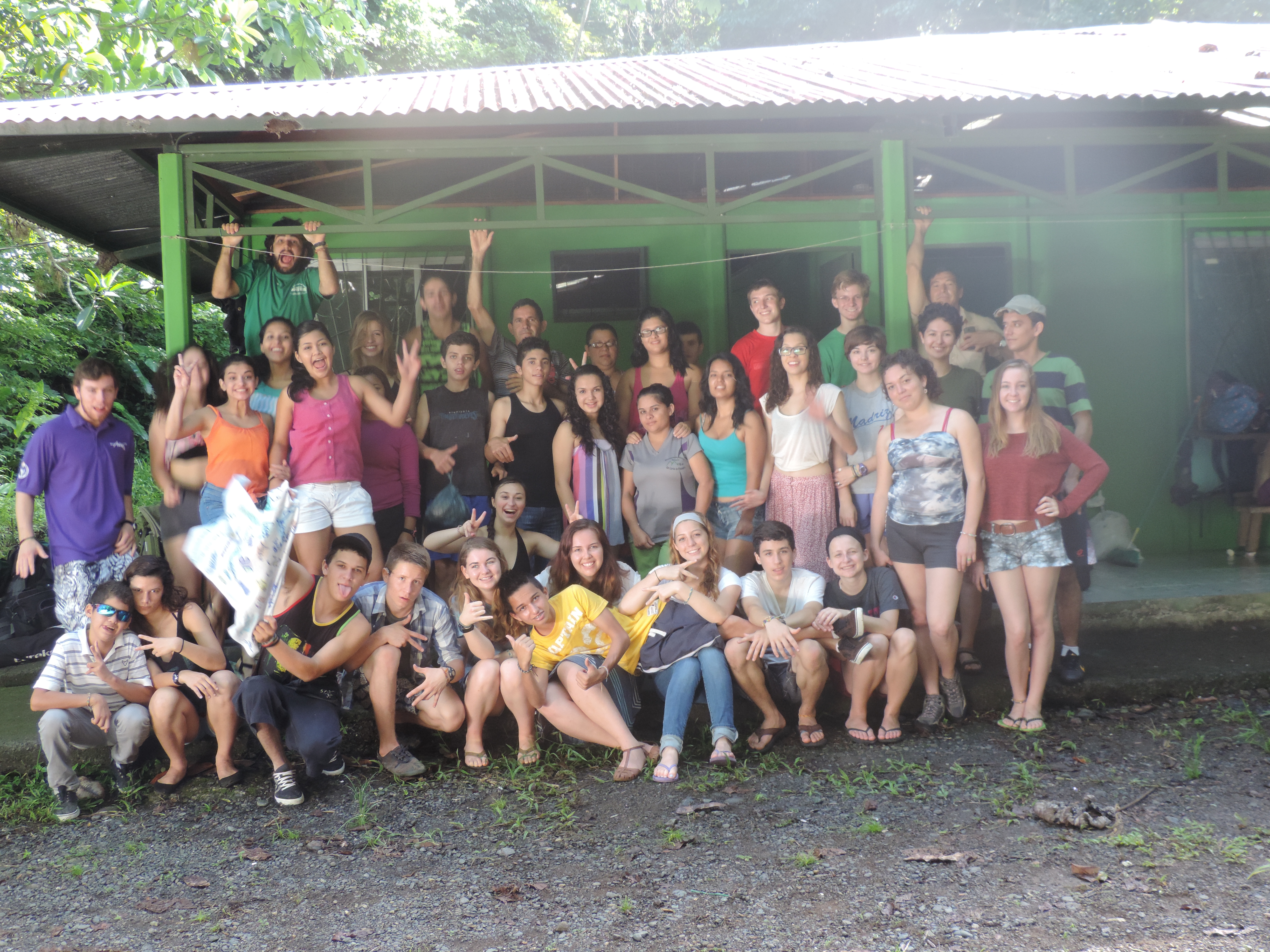
Corinna, Eli y Agathe tratando de golpear la piñata.La vida estudiantil nunca es aburrida.Interactuando con la comunidad.Nuestro grano de oro.Aprendiendo sobre la vida en el cafetal.
Our dear student Eli is our new ping pong champion. He won on his birthday and recieved a “piñata” from his fellow students. That same week, we went on a city tour to down town San José and visited the Mercado Central where we ate and discovered that we all like cas (tropical fruit).
The last activity of the past week was the tour to the coffee mill and coffee plantation. We learned a lot about the process and also visited the town of Barva de Heredia. We had a really good time and here are the photos that prove it!
The hand-painted sign showing two bridled horses does not point towards a fancy place. Turning down this stone driveway off the main road through Las Nubes will not deliver you to a state-of-the-art equine training facility. Nor are these lush pastures described in any Lonely Planet guidebooks. Yet, the animals grazing these hills speak volumes about the culture of Costa Rica’s Central Valley, where horses are not just historical throwbacks but remain essential for work, getting around and showing off in distinctly Tico style.
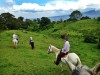
About 5 km from the school “Coronado a Caballo” offers informal, very affordable “cabalgatas” ( trail rides), based out of a modest stable with 50 or so well-cared-for horses, frequented by Ticos much more than foreign tourists. The Costa Rican saddle horses raised here are colloquially known as “criollos,” descended from Spanish and Peruvian breeds. Some are trained to make impressive, dance-like movements, with dramatic knees and dropped noses, like someone who sees a spider in every step. The trail horses are less flashy, with smooth sure-footed gaits even in rough terrain.
The hills and farms east of our Coronado campus certainly qualify. While only a short distance from the most densely populated and urbanized cities in the country, much of the highlands are still only accessibly by horse, motorbike or 4×4 vehicle. The road to Las Nubes disintegrates into skeins of rock and mud about 10 km from the school as it passes near the edge of Braulio Carrillo National Park.
Horseback riding provides unique panoramic views of the Central Valley below, the Cordillera Central mountains and cloud forests above. Plus that sense of freedom and possibility that for whatever reason, only seems to come when you’re a meter off the ground on the back of a trusty horse.
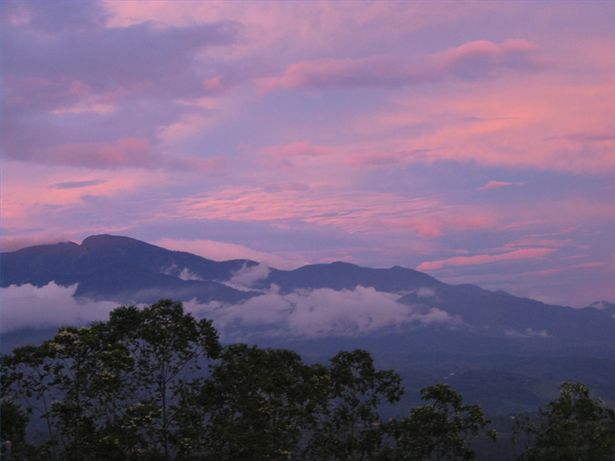
The light and the land in Coronado, San Jose, Costa Rica.
Up the hill from Academia Tica Coronado a cozy little place by the side of the road serves up about the freshest trout imaginable, Tico style.
At this family-run “trucheria,” (trucha means trout), you can catch your own lunch from a backyard pond. Luckily professionals take over from there. Have a seat in the rustic dining room as the fish is seasoned and grilled to perfection, then served with rice, fries, plantains and salad. To find this authentic cultural gem, take the bus to Las Nubes to the very last stop in Cascajal, then keep going up the road by foot. This 3km walk wends through beautiful pastures with sweeping views of the Central Valley. Look for reassuring signs that say “Bella Vista Trucheria, XX metros.” You have arrived when a sign in a driveway on the left that says, “Bienvenidos” with a giant fish painting. Open weekends and holidays.
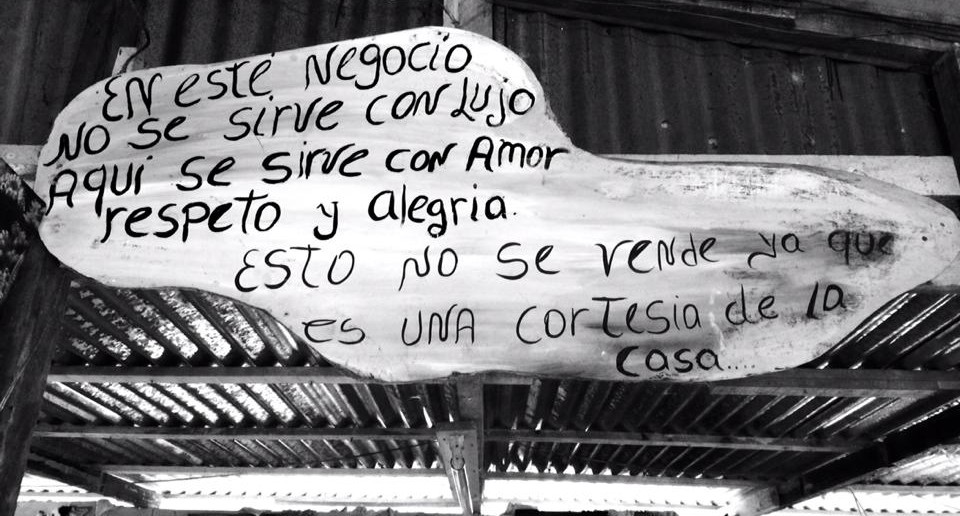
This sign spells out the philosophy at Bella Vista Trucheria in Coronado.Fresh trout served at a homespun restaurant near Academia Tica Coronado.
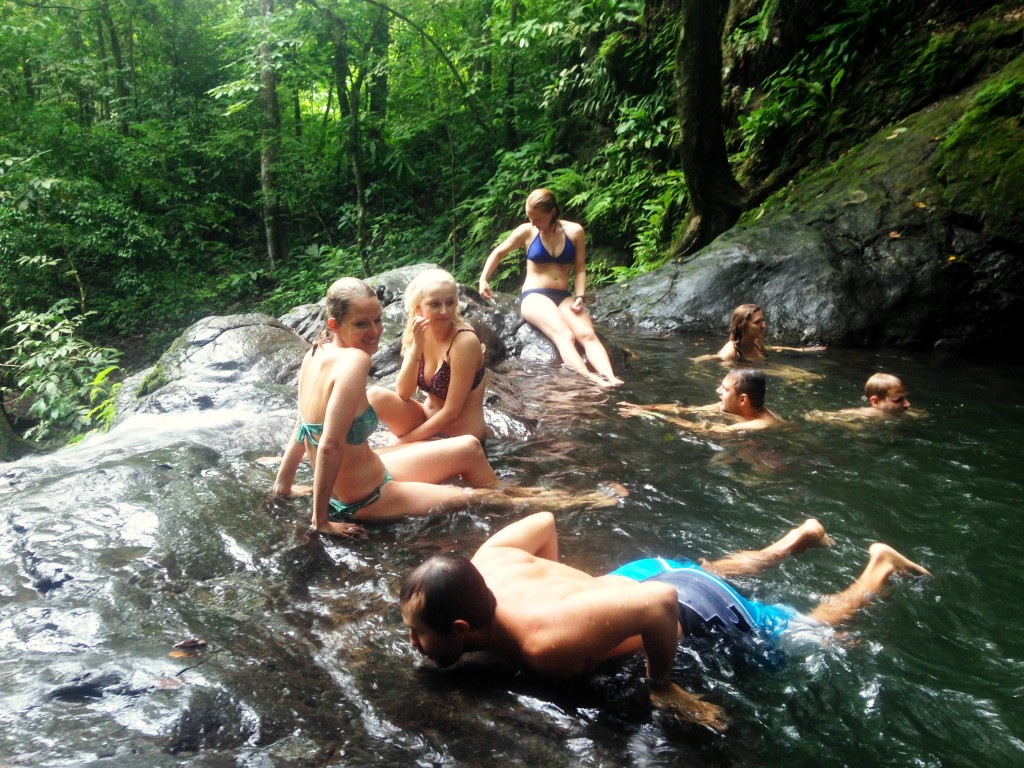
One Friday morning in Jacó Beach: Our group of seven Academia Tica students was being picked up in front of the apartments by Alan, our tour guide for the day. A 45 minutes drive southbound along the coast led us to the beginning of a narrow path through private farmland. First we passed chicken and horses, then the trail continued through the forest, crossing some little streams. Finally we reached the waterfall that made its way down through the jungle like a stairway for giants. Beautiful to see…and now what? I thought the hike would continue to the other ones – since the only thing I knew about the waterfalls back then was: there are at least 3 of them. And it did, just not in the way I expected. Alan began to climb up the rock wall beside the waterfall. We all watched him disappear as he jumped into the pool above. So we left our things at the bottom and followed him up. The second waterfall filled a nice deep pool where some of us dipped in (or in my case: half accidently slipped in). The others were already on their way up higher.
“Once you are up there, the only way down is to jump!” Alan pointed out to us with a provocative twinkle in his eyes. Hesitating and still not quite sure about jumping down the not entirely vertical rock face, I climbed up next to the waterfall holding on to roots and little ledges. Once up there you could see the third and fourth waterfall with their round pools caved out of the dark rock around. The view down into the jungle was amazing! After another swim in the refreshing clear pools and a little massage of the top one of the waterfalls, it was time for the way back down.
Academia Tica students relaxing in the refreshing pool between two waterfalls.
Jumping from the upper waterfall was really fun. One by one we climbed to a spot where you could just let yourself fall into the pool a few meters beneath. The more than 5 meter jump into the last pool was a bit more thrilling. You had to stand on a little ledge where only your heels could fit and from that point jump forward since the rocks were not that steep. But we all did it – there was no other way, right? At this point big respect for Bob, one of the students in his seventies, who enjoyed it as much as everyone else! Full of adrenaline some of us jumped over and over again while the others were relaxing in the pool or tried (and partly succeeded) climbing up beneath the waterfall not being able to see where your hands could grip since the water kept lashing down onto your face.
Perfectly content and definitely with an unforgettable experience more we later made our way back to Jacó. What a fun and unique day.
¡PURA VIDA!
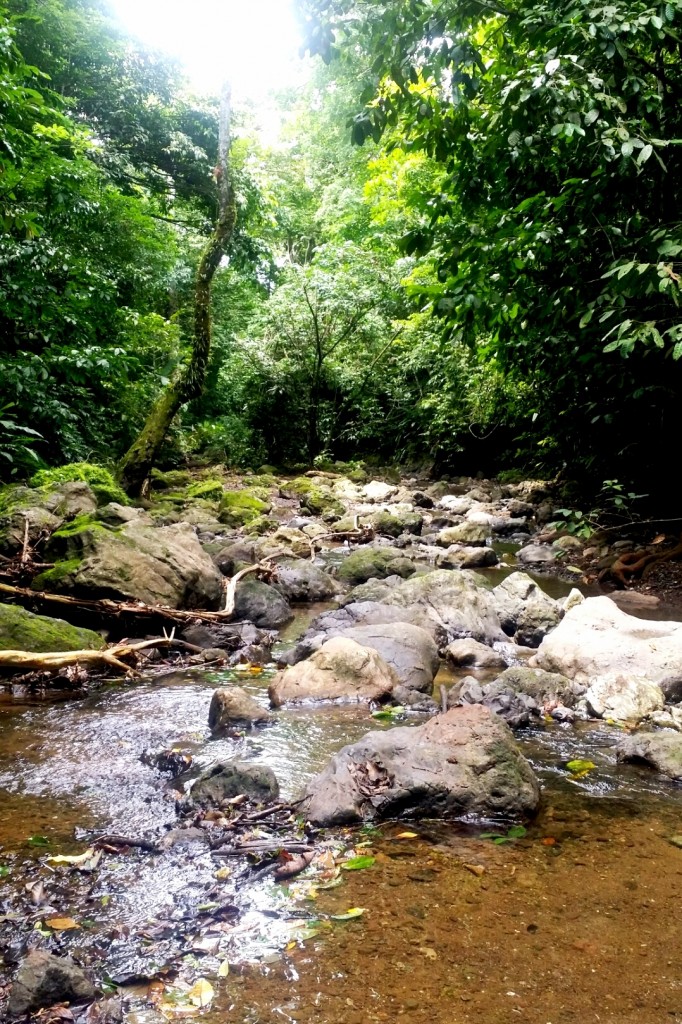
Fresh clear water making its ways through the forest at “Las Cataratas Las Pilas” near Parrita.
In the tangle of cacophonous green that is Carara National Park, two types of forest meet, a mix of plants, animals and insects found nowhere else in the world.
This convergence of Costa Rica’s dry Northern Pacific region and its much wetter Southern Zone is host to half the known animal species in a country famed for prodigious biological diversity. For a while this year it was also host to an unlikely combination of young people, half from the United States and half from Costa Rica, all volunteers.
This group arrived at Carara much to the discomfort of an iguana family that had taken up residence in the bunkhouse. The impressive green lizards stomped around the metal roof and glared from the rafters as the people set to work building infrastructure and breaking down cultural barriers during week-long “campamentos.”
Throughout July, six of these work parties were organized at three national parks through a not-for-profit partnership between youth leadership organizations Casa de La Juventud of San Isidro de General, Perez Zeledon, and AMIGOS de las Americas, headquartered in Houston, Texas. During the project, 14- to 29-year-old volunteers from the U.S. and Costa Rica were overseen by slightly older AMIGOS supervisors and CASA coordinators, who reported to a pair of project directors under 30.
“It’s a very egalitarian organization, where everyone’s point of view counts,” said Airon Corrales Vargas, a 26-year-old coordinator from Tambor, Perez Zeledon.
Airon is a student and teacher at La Universidad Nacional, who first got involved with this program after AMIGOS worked in his hometown. His family has hosted numerous North American volunteers over the years.
Typically, AMIGOS partners with organizations in Latin American countries to place young people from the U.S. with unpaid host families in rural communities like Tambor, where they spend two or three months working on a project identified by the locals. These projects take as many forms as there are places in the organization’s network, from improving public spaces to developing after-school programs. Spanish language skills are a must for participants. Costa Rica is distinct from other AMIGOS programs in that it is the only country in which volunteers leave the host communities to work alongside local youth within a national park system.
But one of the many residents at Carara National Park in July.
One group tarried along the trail at Carara during a morning hike. It crossed a bridge and descended concrete stairs built by the prior campamento. A few people rested under a recently repaired shade structure as a venomous toad hopped out of sight.
“Look!” breathed Jeffry Lopez Navarro, a 14-year-old from San Carlos, Perez Zeledon, redirecting all eyes upwards to where two dark forms clung to a trunk many stories overhead.
“The one way above is a bird’s nest and the one below it is a bee hive.”
In Carara tall trees like this cut straight to the heart of a tropical sun, while an array of shade-loving shrubs blanket the spongy forest floor, a melange of rotting stuff laced in delicate fungal mycelia. In between grow the epiphytes, plants that live on other plants. Even with all 36 campamento participants stomping along, it was hard to look into the vegetative weave without seeing something move. Human ears attuned to the dart of lizards, the yowl of monkeys, the flutter of butterflies, the flapping of wild turkeys or the total silence of a huge spider, ever wakeful on its low-hanging web.
Then came the sloth, seemingly caught mid-chew as it gazed down from the highest reaches of a tree. Unmoving and camoflauged by a symbiotic moss that grows on its gray coat, it looked a lot like a branch with eyes.
Meanwhile, a termite colony ceaselessly sculpted fallen wood. Hundreds of black caterpillars folded into the creases of a wild cashew tree. “Maybe doing something reproductive,” someone guessed. And the ants. Everywhere ants: boring into packed red earth, clipping tons of electric green leaf matter and carrying it home over the 12-lane micro-super-highways that crossed the trail.
“Those ants carry leaves back home, where they turn it into food, a kind of fungus the colony eats,” explained 23-year-old Allan Chinchilla Naranjo.
After the hike he leaned against the wall in the common area of the bunkhouse, musing about Carara and what it’s like to have two volunteers from the U.S. live with his family in San Pablo, Perez Zeledon, where they grow sugar cane and coffee.
“Of course there are things that are difficult. Understanding each other, for example, because they are learning the language. But the girls came to my house and became like my sisters, like my nieces and my cousins,” he said.
For Allan, this experience dismantled a lot of stereotypes.
“We thought all Americans eat a lot of McDonald’s, but in reality McDonald’s is everywhere. The girls seem to like typical Costa Rican food, you know, rice, beans, plantains and salad,” he said.
But for Lizzie Mombello, a 17-year-old volunteer from Kansas City, Missouri, many of the stereotypes she heard about Costa Rican culture are panning out.
“I read a lot of articles before the trip, which described Ticos as polite, generous, loud and knowledgable about their country. That all seems true. Though, even in the US, every state, every place is different and I am learning that here,” she said.
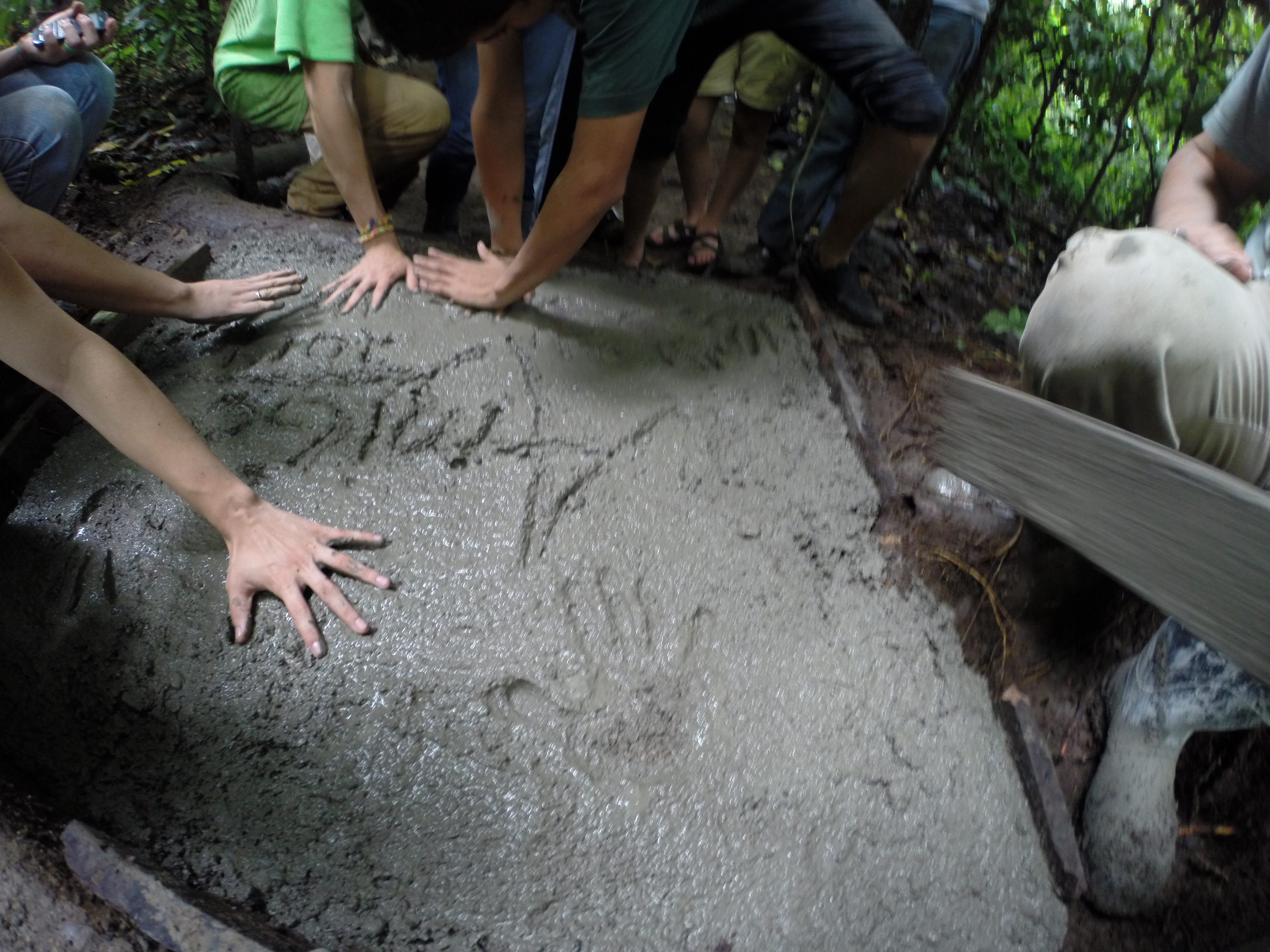
Volunteers leave their mark at Carara National Park in Puntarenas, Costa Rica.
The trip to Costa Rica was her first time on an airplane, her first time away from her own family.
“Luckily, my Tico family is very similar in a lot of ways. I have three siblings at home and my family here has three siblings. The house gets loud and there is always something happening,” she said.
And if there was a dull moment at Carara this reporter did not see it.
In addition to widening three kilometers of trails, moving more than 400 rocks the size of coconuts, shoveling untold amounts of organic debris, pouring concrete, mending a roof, wielding machetes with aplomb, repairing wooden railings and cleaning choked gutters, the group made time to play, to plan, to name the iguanas and some of the rocks, too.
During Lizzie and Allan’s week, fellow volunteers created an obstacle course. As the designers gleefully explained its requirements, the sky opened up, drenching everyone to the bone. Veins of mud flowed where there were once paths. The undaunted took their marks, rain only cheering them on.
Imagine the full force of heaven upon you as you hold a silver spoon in clenched teeth, balancing a lime on the end and walking through a muddy ditch. Then jump into a barrel full of dirty water, belly crawl under a wire through a gravel trench, high-jump halfway up a tree, spin around a broom stick ten times and in this state try to kick a soccer ball through a goal no wider than an umbrella. Next, scramble barefoot up a 30-degree slope slicked by plastic and soap, then tie one of your ankles to your partner’s and hobble 50 or so meters. Hooray! You made it to the finish line! But this is not so much a symbolic tape to be victoriously dashed through as a high, taut rope to be jumped over, using only your partner for help.
There was some confusion over which team won this race, dreamed up by a commission of six volunteers tasked with planning recreational activities during the week. Other commissions facilitated training in first aid, tool use, cultural education and multimedia projects. They all took turns organizing nightly meetings or “asambleas,” and helping the volunteer cooks from Perez Zeledon prepare for and clean up after meals.
“We try to put the campamento in the hands of the volunteers,” said Alessandro Broido, a Texas-born 25-year-old Senior Project Supervisor with AMIGOS and the only paid participant at the campamento.
“The intention is to create an inclusive space where everybody can express their ideas and share whatever they want to bring to the table,” he said.
After the obstacle course, mud streamed from clothes, skin, hair, smiles. Some people took showers, others just stood in the downpour until it rinsed them cleanish. That night Lizzie reflected on the experience, chunks of dirt mooning under her fingernails.
“Every person has different capabilities. For some people jumping over the rope was easy, for others it was running up the slide. Everyone comes from a different place and that’s what makes them who they are. A lot of my being here is about helping me find myself, about finding out what fascinates me. I think that is people and language.”