Category: Uncategorized

  • Costa Rica’s stone balls join World Heritage

    Costa Rica’s stone balls join World Heritage

    Costa Rica’s iconic stone spheres have been recognized for their value to World Heritage by the United Nations Educational, Scientific and Cultural Organization (UNESCO), bringing more international attention to the southern region’s mysterious past, as well as its contentious future.

    No one knows who made a single one of the preColombian stone spheres, let alone why more than 300 were sculpted to near geometric perfection more than 1,000 years ago. Like Stonehedge and Easter Island, the petrospheres have piqued archaeological inquiry and fantastical supposition since the first examples were unearthed by banana plantation workers in the mid-19th century.

    Ranging in size from a child’s fist to a wrecking ball, some arrangements suggest that the spheres aligned with the stars or served as monumental compasses. Local lore has it that they were the playthings of a god hell-bent on controlling the weather, still other theories contend they make perfect instruments for ancient alien air traffic control. The truth is, no one really knows what the original sculptors had in mind or even exactly when they lived.

    The endurance of mystery may be just another reason for Las Bolas to join UNESCO’s elite list of sites thought to exemplify human heritage, so often defined by desperately wanting to know, rather than actually knowing. Officially, the qualifying criteria for the sphere sites is that they “bear a unique or at least exceptional testimony to a cultural tradition or to a civilization which is living or has disappeared.”

    (With La Sele’s historic upset advance to the finals of the World Cup, we can bear witness to the fact that ball-centrist culture has anything by disappeared.)

    The stone balls of yore were probably hand-carved by ancestors of the Boruca, Téribe and Guaymi peoples in Southern Costa Rica. Some believe ancients formed the rocks by dissolving them with a plant-based potion, though many scholars refute this. The exact timeline of production is also a point of debate. Unlike organic materials, rock cannot be carbon-dated. The approximate ages of the spheres are based on associated materials, usually sediments and pottery shards found at the installation site, which indicate that they could have been made during an 1,800 year period. (For some perspective: that’s considerably longer than the Spanish Monarchy has even existed).

    Some of the bolas are thought to weigh more than 15 tons. Others have been pocketed and used as mantle decorations. The UNESCO listing only applies to balls with a diameter of 70 cm or larger and its unclear how or if it will affect the many spheres that have been removed from Costa Rica. Of more than 300 recorded petrospheres found in the southern region about a dozen remain in their original context, according to an educated estimate by John W. Hoopes, an archaeologist whose research contributed to the UNESCO listing.

    “The main that this listing does is draw worldwide global attention to this site and others. The conservation of the site is ultimately the responsibility of the country in which its found,” Hoopes said via Skype. 

    Most if not all “in situ” spheres left are at the four locations recognized as international patrimony by UNESCO this week: Finca 6, Batamba, El Silencio and Grijalba 2. A new museum at Finca 6, a former banana plantation, gives the public a chance to see the spheres as they were installed centuries ago.

    An ancient stone sphere in a new context at Plaza Democracia in San José, Costa Rica. Of more than 300 known spheres, all but a dozen or so have been moved from their original locations in the southern zone.
    An ancient stone sphere in a new context at Plaza Democracia in San José, Costa Rica. Of more than 300 known spheres, all but a dozen or so have been moved from their original locations in the southern zone.

    The rampant damage and dispersion of the spheres began after United Fruit Company workers uncovered the first examples while clearing banana fields in 1940. Since then many have been rolled into gullies and ravines. Others were burned and cracked by fire when land was cleared for plantations. Still others were dynamited, or sent to faraway lands and used as prized lawn ornaments. Paris has one, so does Harvard. Some were stolen, others sold to the highest bidder.

    It seems the predominate human impulses upon encountering one of these testimonies to human heritage are to a) dig it up, b) roll it away or c) blow it up and hope gold falls out. (It doesn’t).

    The solid rock from which the spheres were sculpted came from the Talamanca Mountains and was probably naturally flooded to the lowlands down the Térraba River to the Diquís valley, where boulders would have been collected and transported upwards of 50 miles to some installation sites. Today the Diquís valley is the planned site for the largest hydro-electric project ever in Central America, a dam on the Superior General River between Buenos Aires, Osa, and Pérez Zeledón. In the works under another name for more than 30 years, construction began in 2009, but was stalled in 2011 by a lawsuit over indigenous rights and remains delayed by the construction of an associated pipeline. The El Diquís project would flood 6815 ha  (27 sq mi) to create 631 megawatts of power for 1 million consumers, many of them in Panama, according to the Institute for Costan Rican Electricity ICE. It would inundate protected indigenous territories, displacing at least 1,500 people and “irremediably affecting” 150 archaeological sites, according to an impact summary by the University of Costa Rica.

    For more context about the World Heritage site designation, check out this article en español.

    President Solis poses with a stone sphere in San José after four archaeological sites in Southern Costa Rica were added to UNESCO's World Heritage List.
    President Solis poses with a stone sphere in San José after four archaeological sites in Southern Costa Rica were added to UNESCO’s World Heritage List.

    -Emily Jo Cureton

  • Amazing corn

    Amazing corn

    We loaded our plates with fresh empañadas, cheesy tortillas and sweet chorreadas, unwrapping huge banana leaves to reveal steaming tamales filled with  veggies and meat. We ohhed, ahhed and salivated over the tamal asado, a sticky sweet cornbread that frankly put me over the edge of satisfied, too full to try any more typical Costa Rican dishes made from maize, the star ingredient in this Tuesday tasting class.

    When we look at any Costa Rican table today, chances are at least one thing on it was born of corn, that versatile staple vital to life all over the Americas since time immemorial. If we were to dig in the gooey sediment of Guanacaste lakes, we would uncover 5,000 year old maize pollens. If we dove to the bottom of Arenal Lagoon, we might resurface with charred cobs from 2000 BC. But even as technology like carbon-dating and genetic sequencing shuck the history of modern maize, its origins remain mysterious and its future uncertain.

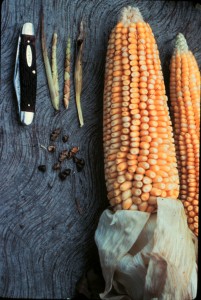
    Modern corn with its diminutive ancestor, teosinte.
    Modern corn with its diminutive ancestor, teosinte.

    Most scholars agree maize was domesticated between 7,500 and 12,000 years ago in Mexico. Its nearest wild relative is a grass species called teosinte, in which each teeny tiny kernel is enclosed in a hard shell. It remains unclear how prehistoric Americans managed to cultivate the starchy stuff of tamales from this unpromising ancestor, itself barely a mouthful, hardly worth the effort for even the most industrious omnivore.

    Mankind’s unlikely mastery of maize has far from run its course. In 2013, some 32 percent of corn grown in the entire world was genetically modified in some way, meaning it contained genes that were altered by humans with the intention of making the crop more productive, resistent to drought, bugs and blights, or some combination of these. About 90 percent of corn grown in the United States that year came from GM seeds, which are typically patented by the multinational corporations that developed them.

    Because of patents, farmers can not legally use GM seeds without buying new ones every single season. For example, Monsanto, one of the world’s biggest and most profitable GMO producers, pursued 145 lawsuits relating to patent control between 1997 and 2012.

    We need not root around very long to get an earful about GMOs. Many say patent laws foster monopolies that put small farmers out of business while monocultures (single crop plantations) are underming soil longevity and overall ecosystem health as they wreak unintended havoc on human health, too. Others say that GMOs are a necessary innovation in agriculture, one that allows us to use less while producing more, developed in response to ballooning populations and dwindling water supplies.

    The debate over GM corn is a fiery one in a country where extensive agriculture and extremely high biological diversity coexist. Currently, Costa Rica does not produce GM corn, (however, GM cotton, soybeans, pineapple and banana plots are grown here). This exclusion could change soon. In Jan. 2013 a subsidiary of Monsanto gained approval from Costa Rica’s National Biosecurity Technical Commission to grow corn, sparking mass protests and a legal appeal, which put the project on hold until Costa Rica’s Supreme Court reviews its constitutionality. By 2013, 66 out of 82 cantons in Costa Rica had passed laws prohibiting GMOs in some way. Still, no national law backs this popular majority and GMO projects are ultimately approved or denied by the feds on a case by case basis.

    The introduction of GM corn is especially high stakes because unlike soybeans and cotton, corn pollinates on the whims of the wind. Many believe GM seeds will contaminate native fields and make it very difficult for farmers to grow heritage crops.

    But when I bit into the chorreadas at Tuesday’s class, I tasted neither the history of civilization nor its fate, just the indescribable sweetness of American corn, smothered in sour cream.

    Updated 7/8/14: Supreme Court readies to decide GM Corn Challenge

    -Emily Jo Cureton

  • ¡Oé, oé, oé!

    ¡Oé, oé, oé!

    When Costa Rican player Marco Ureña sent a third point into Uruguay’s goal during Saturday’s World Cup game, a nation of spectators already thought to be the happiest people on earth became the most elated people on earth. No one expected the Costa Rican team to hold its own against Uruguay, let alone trounce the 2010 semifinalist team in a 3-1 upset. We watched the exciting second half of the match among the crowd at Club Los Jaules, (a sports club in Coronado where AT students enjoy complimentary membership). We snagged this video of the club’s lounge erupting with joy right after Costa Rica scored the final goal.

    ¡Oé!

  • New adventures

    New adventures

    Welcome to our new blog!

    Here at Academia Tica we  pride ourselves on high caliber in-classroom instruction, while our students and staff remain active participants in the community outside school walls. For us, language learning is not just about traveling, passing a test or getting a new job — it is about cultural understanding and friendship most of all. This is at the heart of why we have been in business more than 25 years and why we still love what we do. Between one campus on the Pacific Coast and another in central Costa Rica, we have lots of amazing experiences to share and we hope this blog will help show what language learning and pura vida are all about!